Rechercher dans ce blog

Friday, March 31, 2023

Economy grew 0.5 per cent in January, Statistics Canada reports - Ottawa.CityNews.ca

OTTAWA — Economic growth resumed in January and came in better than first expected following a small contraction in December, Statistics Canada said Friday.

Real gross domestic product rose 0.5 per cent to start the year, the agency said, beating its initial estimate for a gain of 0.3 per cent for the month and reversing a contraction of 0.1 per cent in the final month of 2022. 

Statistics Canada also said its initial estimate for February indicates growth continued with a gain of 0.3 per cent, though it cautioned the figure will be updated.

"There were many indications that the economy got off to a solid start in 2023, but today's double-barrelled blast of strength is well above even the most optimistic views," BMO chief economist Douglas Porter wrote in a report.

"Even if growth stalls in March, it now looks like Q1 will post growth of 2.5 per cent, up from a flat read in Q4. While we continue to look for a notable cooldown in the next two quarters, we are bumping up our GDP growth estimate for all of 2023 by three ticks to 1.0 per cent."

The growth in January came as goods-producing industries gained 0.4 per cent for the month, while services-producing industries rose 0.6 per cent.

Statistics Canada said many of the main drivers for growth in January also contributed the most to the decline in December.

The wholesale trade, transportation and warehousing, and mining, quarrying and oil and gas extraction sectors all rebounded after falling in the previous month.

Wholesale trade gained 1.8 per cent in January, helped by wholesalers of machinery, equipment and supplies, while the mining, quarrying and oil and gas extraction sector grew 1.1 per cent after falling 3.3 per cent in December.

The transportation and warehousing sector added 1.9 per cent in January, more than offsetting a drop of 1.1 per cent in December that was due in part to bad weather.

This report by The Canadian Press was first published March 31, 2023.

The Canadian Press

Adblock test (Why?)


Economy grew 0.5 per cent in January, Statistics Canada reports - Ottawa.CityNews.ca
Read More

U.S. revises down last quarter's economic growth to 2.6% rate - The Globe and Mail

A construction worker prepares a recently poured concrete foundation, in Boston, on March 17.Michael Dwyer/The Associated Press

The U.S. economy maintained its resilience from October through December despite rising interest rates, growing at a 2.6 per cent annual pace, the government said Thursday in a slight downgrade from its previous estimate. But consumer spending, which drives most of the economy’s growth, was revised sharply down.

The government had previously estimated that the economy expanded at a 2.7 per cent annual rate last quarter.

The rise in the gross domestic product – the economy’s total output of goods and services – for the October-December quarter was down from the 3.2 per cent growth rate from July through September. For all of 2022, the U.S. economy expanded 2.1 per cent, down significantly from a robust 5.9 per cent in 2021.

The report suggested that the economy was losing momentum at the end of 2022.

Consumer spending rose at a 1 per cent annual rate last quarter, downgraded from a 1.4 per cent increase in the government’s previous estimate. It was the weakest quarterly gain in consumer spending since COVID-19 slammed the economy in the spring of 2020. Spending on physical goods, like appliances and furniture, which had initially surged as the economy rebounded from the pandemic recession, fell for a fourth straight quarter.

More than half of last quarter’s growth came from businesses restocking their inventories, not an indication of underlying economic strength.

Most economists say they think growth is slowing sharply in the current January-March quarter, in part because the Federal Reserve has steadily raised interest rates in its drive to curb inflation.

The resulting surge in borrowing costs has walloped the housing industry and made it more expensive for consumers and businesses to spend and invest in major purchases. As a consequence, the economy is widely expected to slide into a recession later this year.

The central bank has raised its benchmark interest rate nine times over the past year. The Fed’s policy-makers are betting that they can stick a so-called soft landing – slowing growth just enough to tame inflation without tipping the world’s biggest economy into recession.

Yet as higher loan costs spread through the economy, analysts are generally skeptical that the United States can avoid a downturn. The main point of debate is whether a recession will prove mild, with only minor damage to hiring and growth, or severe, with waves of layoffs.

The financial conditions that led to the collapse of Silicon Valley Bank on March 10 and Signature Bank two days later – the second– and third-biggest bank failures in U.S. history – are also expected to slow the economy. Banks are likely to impose stricter conditions on loans, which help fuel economic growth, to conserve cash to meet withdrawals from jittery depositors.

“The economy ended 2022 with marginally less momentum,” Oren Klachkin and Ryan Sweet of Oxford Economics wrote in a research note. “Looking ahead, the economy will face the full brunt of tighter credit conditions and Fed policy this year, and inflation is set to stay above its historical trend.” They added: “We expect a recession to hit in the second half of 2023.”

In the meantime, the job market remains robust and has exerted upward pressure on wages, which feed into inflation. The pace of hiring is still healthy, and the unemployment rate is near a half-century low. The confidence and spending of consumers remain relatively solid.

Thursday’s report from the Commerce Department was its third and final estimate of GDP for the fourth quarter of 2022. On April 27, the department will issue its initial estimate of growth in the current first quarter. Forecasters surveyed by the data firm FactSet have estimated that growth in the January-March quarter is decelerating to a 1.4 per cent annual rate.

Adblock test (Why?)


U.S. revises down last quarter's economic growth to 2.6% rate - The Globe and Mail
Read More

Economy grew 0.5 per cent in January, Statistics Canada reports - Ottawa.CityNews.ca

OTTAWA — Economic growth resumed in January and came in better than first expected following a small contraction in December, Statistics Canada said Friday.

Real gross domestic product rose 0.5 per cent to start the year, the agency said, beating its initial estimate for a gain of 0.3 per cent for the month and reversing a contraction of 0.1 per cent in the final month of 2022. 

Statistics Canada also said its initial estimate for February indicates growth continued with a gain of 0.3 per cent, though it cautioned the figure will be updated.

"There were many indications that the economy got off to a solid start in 2023, but today's double-barrelled blast of strength is well above even the most optimistic views," BMO chief economist Douglas Porter wrote in a report.

"Even if growth stalls in March, it now looks like Q1 will post growth of 2.5 per cent, up from a flat read in Q4. While we continue to look for a notable cooldown in the next two quarters, we are bumping up our GDP growth estimate for all of 2023 by three ticks to 1.0 per cent."

The growth in January came as goods-producing industries gained 0.4 per cent for the month, while services-producing industries rose 0.6 per cent.

Statistics Canada said many of the main drivers for growth in January also contributed the most to the decline in December.

The wholesale trade, transportation and warehousing, and mining, quarrying and oil and gas extraction sectors all rebounded after falling in the previous month.

Wholesale trade gained 1.8 per cent in January, helped by wholesalers of machinery, equipment and supplies, while the mining, quarrying and oil and gas extraction sector grew 1.1 per cent after falling 3.3 per cent in December.

The transportation and warehousing sector added 1.9 per cent in January, more than offsetting a drop of 1.1 per cent in December that was due in part to bad weather.

This report by The Canadian Press was first published March 31, 2023.

The Canadian Press

Adblock test (Why?)


Economy grew 0.5 per cent in January, Statistics Canada reports - Ottawa.CityNews.ca
Read More

Canada's economy jumps back to life after stalling last year: What you need to know - Financial Post

Economy's resilience means higher interest rates remain a possibility this year

Get the latest from Kevin Carmichael straight to your inbox

Article content

Statistics Canada on March 31 said Canada’s economy surged back to life at the start of the year after stalling at the end of 2022, complicating the Bank of Canada‘s efforts to get inflation back to its two-per-cent target. Here’s what you need to know:

Advertisement 2

Article content

  • Gross domestic product, as measured by industrial output, increased 0.5 per cent in January from the previous month, more than reversing a 0.1 per cent drop in December.
  • GDP increased an additional 0.3 per cent in February, according to Statistics Canada’s “flash estimate,” which is based on preliminary data.
  • Seventeen of the 20 broad industries that Statistics Canada monitors posted gains, led by wholesaling, which increased 1.8 per cent from December. Mining, quarrying, and oil and gas gained 1.1 per cent.
  • The Canadian dollar increased somewhat, and short-term bond yields rose, as traders repositioned amid expectations that the Bank of Canada will leave interest rates high for long

Article content

Article content

Backstory

Canada’s economy was supposed to be in a recession by now. At least that was the vibe for much of last year, as economists reckoned the most severe burst of inflation in four decades and the most aggressive series of rate hikes in the Bank of Canada’s history would combine to sink the recovery from the COVID-19 crisis.

Article content

Advertisement 3

Article content

The economy slowed, but nowhere near as much as forecasters predicted, as a surprisingly strong labour market offset the effects of higher living costs. Earlier this year, it looked like Canada’s impressive run had finally run out of track when Statistics Canada reported that GDP growth stalled in the fourth quarter, aligning with the Bank of Canada’s prediction that there would be essentially no growth for the first part of 2023.

But some economists observed the fourth-quarter numbers were influenced by an unusually large depletion of inventories, suggesting the economy might still have some spark. That appears to be the case, as many industries that posted declines in December rallied in January.

Where is the growth coming from?

Advertisement 4

Article content

The latest GDP numbers suggest the rebound from December was a mix of predictable reversions to trend and a surprisingly resilient current of demand.

Recall that Enbridge Inc. spent time in December cleaning up a spill from its Keystone pipeline in Kansas, which slowed oil exports to the United States. Shipments had resumed to normal in January. Another example of one-off explanations: output by wholesalers of machinery and equipment surged 2.4 per cent in January as suppliers received a batch of imports destined for the massive LNG Canada liquefied natural gas project in British Columbia.

But math doesn’t explain everything.

The jobless rate is near a historic low, which appears to be offsetting higher inflation and debt-servicing costs. Wages are growing faster than prices for the first time in two years, bolstering consumer confidence. Retail trade, accommodation and food services, and arts and entertainment — industries that are closely linked to consumer discretionary spending — all posted solid gains. The demand destruction that so many economists predicted hasn’t happened yet.

Advertisement 5

Article content

What does it mean for interest rates?

The Bank of Canada stopped raising interest rates for the first time in a year on March 8. Headline inflation had been steadily dropping from its peak in June, so policymakers said it was appropriate to pause and assess the situation. Governor Tiff Macklem had made it clear he didn’t want to cause a recession if he could avoid it.

However, policymakers emphasized they were still worried about inflation and would err on the side of getting year-over-year increases in the consumer price index back to two per cent. (Inflation was 5.2 per cent in February.) That means another interest rate increase will be on the table when Macklem and his deputies gather to update policy on April 12.

Advertisement 6

Article content

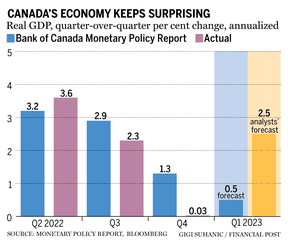
Faster economic growth will be a concern for the central bank only because it will exert upward pressure on inflation. (That’s why it tends to take a recession to bring price increases under control.) But policymakers will probably look at these numbers and call it a wash. Their quarterly economic outlook in January predicted a 1.3 per cent annual rate of growth in the fourth quarter, not zero, which is what Statistics Canada’s actual tally produced.

The Bank of Canada’s outlook for growth in the first quarter was 0.5 per cent, and some economists said the January and February monthly figures imply the economy is growing at an annual rate of about 2.5 per cent.

  1. Canada's economy is so far defying expectations for a pullback.

    What economists are saying about latest GDP numbers

  2. Statistics Canada says retail sales rose 1.4 per cent to $66.4 billion in January, helped by gains at motor vehicle and parts dealers as well as gas stations.

    Canadian consumer remains strong, January retail sales show

  3. Economist David Rosenberg at an event in Toronto, in January.

    Canada is a buying opportunity despite series of headwinds

Advertisement 7

Article content

The gains in January and February could represent some of those sparks of strength the Bank of Canada already thought it was seeing. That calculation will probably be enough to leave interest rates unchanged in April. But the economy’s resilience means higher interest rates remain a possibility this year, and the rate cuts that some forecasters see on the horizon remain a distant bell.

• Email: kcarmichael@postmedia.com | Twitter: carmichaelkevin

An earlier version of this story stated that the Bank of Canada predicted the economy grew at an annual rate of 0.5 per cent in the fourth quarter. That was its prediction for the first quarter. The mistake has been corrected.

Comments

Postmedia is committed to maintaining a lively but civil forum for discussion and encourage all readers to share their views on our articles. Comments may take up to an hour for moderation before appearing on the site. We ask you to keep your comments relevant and respectful. We have enabled email notifications—you will now receive an email if you receive a reply to your comment, there is an update to a comment thread you follow or if a user you follow comments. Visit our Community Guidelines for more information and details on how to adjust your email settings.

Join the Conversation

Adblock test (Why?)


Canada's economy jumps back to life after stalling last year: What you need to know - Financial Post
Read More

Thursday, March 30, 2023

Brazil Central Bank Sees Economy Growing Faster Than Forcast - Financial Post

China’s Big Banks See Profit Gains Despite Slowing Economy - BNN Bloomberg

(Bloomberg) -- China’s biggest state-owned banks delivered profit gains last year after boosting lending to help cushion the economy from a slowdown triggered by the nation’s strict pursuit of Covid zero.

Industrial & Commercial Bank of China Ltd., the country’s biggest lender by assets, reported Thursday that net income rose 3.5% to 360.5 billion yuan ($52.4 billion), short of analysts’ estimates. Other banks topped or met forecasts, including Agricultural Bank of China Ltd., whose profit rose 7.4% to 259 billion yuan last year. Bank of China Ltd. posted a 5% profit increase, while Bank of Communications Co. earlier reported a 5.2% gain.

China’s $54 trillion banking industry has been pushing to extend more credit in the past year as it grappled with low demand. A strict Covid-zero policy, abandoned in late 2022, had weighed on economic growth and sapped consumer confidence. A persistent slump in the property market has also impacted business.

Analysts have been cautious about the outlook for banks, even after several of the big banks reported profits that beat estimates. Although China’s economic activity is rebounding this year after lifting Covid restrictions — with banks extending a record amount of new loans in January — headwinds still exist. 

China’s push for state lenders to lower borrowing cost for small businesses and home buyers, coupled with a potential loan prime rate cut this year, could pressure margins in 2023, Bloomberg Intelligence analyst Francis Chan said in a note Thursday. Most of the big banks reported declines in net interest margins last year.

Here is a summary of the banks’ full-year net income, net interest margins and non-performing loan ratios from a year earlier:

(Updates with ICBC results)

©2023 Bloomberg L.P.

Adblock test (Why?)


China’s Big Banks See Profit Gains Despite Slowing Economy - BNN Bloomberg
Read More

Wednesday, March 29, 2023

Live news: CFOs upgrade outlook for US economy in 2023 - Financial Times

What is included in my trial?

During your trial you will have complete digital access to FT.com with everything in both of our Standard Digital and Premium Digital packages.

Standard Digital includes access to a wealth of global news, analysis and expert opinion. Premium Digital includes access to our premier business column, Lex, as well as 15 curated newsletters covering key business themes with original, in-depth reporting. For a full comparison of Standard and Premium Digital, click here.

Change the plan you will roll onto at any time during your trial by visiting the “Settings & Account” section.

What happens at the end of my trial?

If you do nothing, you will be auto-enrolled in our premium digital monthly subscription plan and retain complete access for 65 € per month.

For cost savings, you can change your plan at any time online in the “Settings & Account” section. If you’d like to retain your premium access and save 20%, you can opt to pay annually at the end of the trial.

You may also opt to downgrade to Standard Digital, a robust journalistic offering that fulfils many user’s needs. Compare Standard and Premium Digital here.

Any changes made can be done at any time and will become effective at the end of the trial period, allowing you to retain full access for 4 weeks, even if you downgrade or cancel.

When can I cancel?

You may change or cancel your subscription or trial at any time online. Simply log into Settings & Account and select "Cancel" on the right-hand side.

You can still enjoy your subscription until the end of your current billing period.

What forms of payment can I use?

We support credit card, debit card and PayPal payments.

Adblock test (Why?)


Live news: CFOs upgrade outlook for US economy in 2023 - Financial Times
Read More

Carney touts B.C. port expansion plan to strengthen independence, diversify economy - Toronto Star

[unable to retrieve full-text content] Carney touts B.C. port expansion plan to strengthen independence, diversify economy    Toronto Star ...