Rechercher dans ce blog

Saturday, July 3, 2021

Fewer working-age people may slow economy. Will it lift pay? - NEWS 1130 - News 1130

WASHINGTON (AP) — As America’s job market rebounds this summer and the need for workers intensifies, employers won’t likely have a chance to relax anytime soon. Worker shortages will likely persist for years after the fast-reopening economy shakes off its growing pains.

Consider that the number of working age people did something last year it had never done in the nation’s history: It shrank.

Estimates from the Census Bureau showed that the U.S. population ages 16 through 64 fell 0.1% in 2020 — a scant drop but the first decline of any kind after decades of steady increases. It reflected a sharp fall in immigration, the retirements of the vast baby boom generation and a slowing birth rate. The size of the 16-64 age group was also diminished last year by thousands of deaths from the coronavirus.

A year earlier, in 2019, the working age population had essentially plateaued.

It’s not entirely clear how population patterns will unfold once the pandemic fully fades. But even if the working age population resumes growing, it will almost certainly do so at an anemic pace. A continuing drop in that population, or even a tepid increase, would pose a problem for the economy. A healthy economic expansion has always depended on robust population growth to fuel consumer spending, justify business expansion and drive corporate earnings. Without a sizable influx of new workers, growth could stagnate.

Still, some economists foresee a silver lining for individuals: Fewer people of working age could compel companies to compete harder to hire and retain employees. And that could mean higher pay, better opportunities and other inducements to keep and attract workers, a trend already evident in the June jobs report the government released Friday. Average hourly pay rose a hefty 3.6% compared with a year ago, faster than the pre-pandemic pace.

“The workers would be doing better than the economy as a whole,” said Manoj Pradhan, the founder of Talking Heads Marco, an economics research firm, and formerly an economist for Morgan Stanley.

If wages were to rise sharply, it could also help narrow the vast inequality that has increasingly divided the most affluent Americans from everyone else and left the lowest-income households struggling to afford rent, food, child care and other essential expenses.

With population growth sluggish, economic expansion would hinge on whether companies could make their workers more productive. An increase in productivity, often made through investments in labor-saving technology, could further raise pay. Living standards would rise even if the economy struggled to grow at what’s normally considered a healthy pace.

Last year, the number of legal and unauthorized immigrants entering the United States fell for a fourth straight year to below 500,000 — less than half the level in 2016 — according to calculations by William Frey, a demographer at the Brookings Institution. The number of deaths jumped 8%, to above 3 million, reflecting largely the impact of the pandemic.

A fundamental long-term drag on the working-age population is the exit of the enormous baby boom generation from the labor force. The number of people ages 65 and over will likely jump 30% over the next decade, Frey said.

“We’ve never really been in this type of situation before,” he said. “There’s just not enough (young adults) to replace people who are leaving.”

The situation has been exacerbated this year by a spate of early retirements. Roughly 2.6 million people who were working before the pandemic now say they’re retired and not searching for a job, according to Federal Reserve Bank of Dallas. Sharp gains in stock prices and home values despite the deep pandemic recession made it easier for many older Americans to leave the workforce early.

One of them is Jeff Ferguson, a physician with Eli Lilly & Co. in Indianapolis, who retired in April at age 59 after 22 years with the company.

Having worked from home during the pandemic, Ferguson said, made the transition smoother. But he was also encouraged by his solid investment gains and by the strengthening of the local housing market despite economic uncertainty.

“I probably retired with a tailwind as opposed to retiring with a headwind,” he said. “If I had perceived a headwind, I might have delayed it.”

The pandemic also lent him a new perspective on life and retirement. Ferguson plans to travel around the country with his wife, a pediatrician, and catch up with relatives.

Gad Levanon, an economist at the Conference Board, said the drop in the working age population will be particularly evident among Americans without college degrees. As aging baby boomers retire, they’re being replaced by younger workers who are likelier to be college graduates. Blue-collar workers — anyone without a four-year degree — will become scarcer. That trend will likely create labor shortages in such industries as manufacturing, construction, retail and restaurants and hotels.

Levanon estimates that the number of college graduates will keep growing about 2% a year, despite the population slowdown, while non-college degree holders will dwindle. This could make it harder for future college grads to find jobs commensurate with their education levels. Companies may also inflate their job requirements, perhaps demanding bachelor’s degrees for jobs that didn’t require them before.

“The number of people who are willing to work in blue collar and manual service jobs is shrinking,” Levanon said.

Pay is already rising faster for lower-wage workers. For the lowest-paid one-quarter of employees, hourly wages rose 4.2% in May compared with a year earlier, according to the Federal Reserve Bank of Atlanta. That’s more than twice the percentage raises that these workers received in the four years after the Great Recession, from 2010 through 2014, and higher than the richest one-quarter of workers.

Scott Seaholm, CEO of Universal Metal Products, a 285-person metal stamping company near Cleveland, is surrounded by an aging population and is trying desperately to interest young people in a manufacturing career. A study found that roughly 59% of the population in Lake County, Ohio, where he’s based, was made up of working age adults in 2015, Seaholm said. That proportion fell to 57% last year and is projected to hit 54% in 2025.

“That’s pretty shocking,” he said. “There’s nobody out there to work. It’s kind of ugly.”

More than half the workers in his three factories are over 55, he said, with fewer than one in five ages 20 to 34. He has one 81-year old employee still working a punch press.

Seaholm’s company belongs to a group that encourages high school students to consider factory jobs. He opens his plants to high school students once a year on “industry day” and tries to get their parents to come, too.

“They want Johnny and Judy to go off to college,” he said. “That’s all locked in their heads.”

Globally, workforces in most other countries are also aging, including in China, which once seemed to offer an inexhaustible supply of workers. Japan’s population has shrunk for a decade.

Pradhan said that trend could potentially benefit American workers. Since the end of the Cold War in the early 1990s, hundreds of millions of people in China, Eastern Europe and India have joined the global workforce, thereby holding down wages for lower-skilled workers and keeping prices in check.

Now, the aging of much of the world could reverse those trends, Pradhan and Charles Goodhart, formerly an economist at the Bank of England, wrote in a book last year titled, “The Great Demographic Reversal: Ageing Societies, Waning Inequality, and an Inflation Revival.”

Pradhan notes that in Japan, whose population has declined about 1% year for a decade, economic growth has averaged just 1% annually. But that means growth per person has been 2%.

If the United States could achieve that level of efficiency while its population grows just 0.5% a year, its economy could still expand at a healthy 2.5% annually, Pradhan said.

Still, over time, he and other economists worry that sluggish population growth could mean less consumer spending and a less dynamic economy.

“Workers generate innovation and ideas — they invent things,” said Kasey Buckles, an economics professor at the University of Notre Dame. “When you have a dwindling working-age population, you have fewer people doing that.”

___

AP Business Writer Anne D’Innocenzio contributed to this report from New York.

Christopher Rugaber , The Associated Press

Adblock test (Why?)


Fewer working-age people may slow economy. Will it lift pay? - NEWS 1130 - News 1130
Read More

Fewer working-age people may slow economy. Will it lift pay? - The Chronicle Journal

WASHINGTON (AP) — As America's job market rebounds this summer and the need for workers intensifies, employers won't likely have a chance to relax anytime soon. Worker shortages will likely persist for years after the fast-reopening economy shakes off its growing pains.

Consider that the number of working age people did something last year it had never done in the nation's history: It shrank.

Estimates from the Census Bureau showed that the U.S. population ages 16 through 64 fell 0.1% in 2020 — a scant drop but the first decline of any kind after decades of steady increases. It reflected a sharp fall in immigration, the retirements of the vast baby boom generation and a slowing birth rate. The size of the 16-64 age group was also diminished last year by thousands of deaths from the coronavirus.

A year earlier, in 2019, the working age population had essentially plateaued.

It's not entirely clear how population patterns will unfold once the pandemic fully fades. But even if the working age population resumes growing, it will almost certainly do so at an anemic pace. A continuing drop in that population, or even a tepid increase, would pose a problem for the economy. A healthy economic expansion has always depended on robust population growth to fuel consumer spending, justify business expansion and drive corporate earnings. Without a sizable influx of new workers, growth could stagnate.

Still, some economists foresee a silver lining for individuals: Fewer people of working age could compel companies to compete harder to hire and retain employees. And that could mean higher pay, better opportunities and other inducements to keep and attract workers, a trend already evident in the June jobs report the government released Friday. Average hourly pay rose a hefty 3.6% compared with a year ago, faster than the pre-pandemic pace.

“The workers would be doing better than the economy as a whole,” said Manoj Pradhan, the founder of Talking Heads Marco, an economics research firm, and formerly an economist for Morgan Stanley.

If wages were to rise sharply, it could also help narrow the vast inequality that has increasingly divided the most affluent Americans from everyone else and left the lowest-income households struggling to afford rent, food, child care and other essential expenses.

With population growth sluggish, economic expansion would hinge on whether companies could make their workers more productive. An increase in productivity, often made through investments in labor-saving technology, could further raise pay. Living standards would rise even if the economy struggled to grow at what's normally considered a healthy pace.

Last year, the number of legal and unauthorized immigrants entering the United States fell for a fourth straight year to below 500,000 — less than half the level in 2016 — according to calculations by William Frey, a demographer at the Brookings Institution. The number of deaths jumped 8%, to above 3 million, reflecting largely the impact of the pandemic.

A fundamental long-term drag on the working-age population is the exit of the enormous baby boom generation from the labor force. The number of people ages 65 and over will likely jump 30% over the next decade, Frey said.

“We've never really been in this type of situation before,” he said. “There's just not enough (young adults) to replace people who are leaving.”

The situation has been exacerbated this year by a spate of early retirements. Roughly 2.6 million people who were working before the pandemic now say they're retired and not searching for a job, according to Federal Reserve Bank of Dallas. Sharp gains in stock prices and home values despite the deep pandemic recession made it easier for many older Americans to leave the workforce early.

One of them is Jeff Ferguson, a physician with Eli Lilly & Co. in Indianapolis, who retired in April at age 59 after 22 years with the company.

Having worked from home during the pandemic, Ferguson said, made the transition smoother. But he was also encouraged by his solid investment gains and by the strengthening of the local housing market despite economic uncertainty.

“I probably retired with a tailwind as opposed to retiring with a headwind,” he said. “If I had perceived a headwind, I might have delayed it.”

The pandemic also lent him a new perspective on life and retirement. Ferguson plans to travel around the country with his wife, a pediatrician, and catch up with relatives.

Gad Levanon, an economist at the Conference Board, said the drop in the working age population will be particularly evident among Americans without college degrees. As aging baby boomers retire, they're being replaced by younger workers who are likelier to be college graduates. Blue-collar workers — anyone without a four-year degree — will become scarcer. That trend will likely create labor shortages in such industries as manufacturing, construction, retail and restaurants and hotels.

Levanon estimates that the number of college graduates will keep growing about 2% a year, despite the population slowdown, while non-college degree holders will dwindle. This could make it harder for future college grads to find jobs commensurate with their education levels. Companies may also inflate their job requirements, perhaps demanding bachelor's degrees for jobs that didn't require them before.

“The number of people who are willing to work in blue collar and manual service jobs is shrinking,” Levanon said.

Pay is already rising faster for lower-wage workers. For the lowest-paid one-quarter of employees, hourly wages rose 4.2% in May compared with a year earlier, according to the Federal Reserve Bank of Atlanta. That's more than twice the percentage raises that these workers received in the four years after the Great Recession, from 2010 through 2014, and higher than the richest one-quarter of workers.

Scott Seaholm, CEO of Universal Metal Products, a 285-person metal stamping company near Cleveland, is surrounded by an aging population and is trying desperately to interest young people in a manufacturing career. A study found that roughly 59% of the population in Lake County, Ohio, where he's based, was made up of working age adults in 2015, Seaholm said. That proportion fell to 57% last year and is projected to hit 54% in 2025.

“That's pretty shocking,” he said. “There's nobody out there to work. It's kind of ugly.”

More than half the workers in his three factories are over 55, he said, with fewer than one in five ages 20 to 34. He has one 81-year old employee still working a punch press.

Seaholm's company belongs to a group that encourages high school students to consider factory jobs. He opens his plants to high school students once a year on “industry day” and tries to get their parents to come, too.

“They want Johnny and Judy to go off to college,” he said. “That's all locked in their heads.”

Globally, workforces in most other countries are also aging, including in China, which once seemed to offer an inexhaustible supply of workers. Japan's population has shrunk for a decade.

Pradhan said that trend could potentially benefit American workers. Since the end of the Cold War in the early 1990s, hundreds of millions of people in China, Eastern Europe and India have joined the global workforce, thereby holding down wages for lower-skilled workers and keeping prices in check.

Now, the aging of much of the world could reverse those trends, Pradhan and Charles Goodhart, formerly an economist at the Bank of England, wrote in a book last year titled, “The Great Demographic Reversal: Ageing Societies, Waning Inequality, and an Inflation Revival.”

Pradhan notes that in Japan, whose population has declined about 1% year for a decade, economic growth has averaged just 1% annually. But that means growth per person has been 2%.

If the United States could achieve that level of efficiency while its population grows just 0.5% a year, its economy could still expand at a healthy 2.5% annually, Pradhan said.

Still, over time, he and other economists worry that sluggish population growth could mean less consumer spending and a less dynamic economy.

“Workers generate innovation and ideas — they invent things," said Kasey Buckles, an economics professor at the University of Notre Dame. "When you have a dwindling working-age population, you have fewer people doing that.”

___

AP Business Writer Anne D'Innocenzio contributed to this report from New York.

Adblock test (Why?)


Fewer working-age people may slow economy. Will it lift pay? - The Chronicle Journal
Read More

Hot Economy? Three Of Four Biggest Months For Trade Ever Are In 2021 - Forbes

Friday, July 2, 2021

U.S. job growth accelerates, economy adds 850K jobs in June - Global News

U.S. job growth accelerated in June as companies, desperate to boost production and services amid booming demand, raised wages and offered incentives to draw millions of reluctant unemployed Americans back into the labor force.

Nonfarm payrolls increased by 850,000 jobs last month after rising 583,000 in May, the Labor Department said in its closely watched employment report on Friday. The unemployment rate rose to 5.9% from 5.8% in May.

Read more: 130 countries back global minimum corporate tax of 15%

The jobless rate has been understated by people misclassifying themselves as being “employed but absent from work.” There are a record 9.3 million job openings. Economists polled by Reuters had forecast payrolls advancing by 700,000 jobs last month and the unemployment rate dipping to 5.7%.

Click to play video: 'Canada, U.S., Mexico looking to strengthen, rebuild economies as trade partners: Ng' Canada, U.S., Mexico looking to strengthen, rebuild economies as trade partners: Ng
Canada, U.S., Mexico looking to strengthen, rebuild economies as trade partners: Ng – May 18, 2021

Average hourly earnings rose 0.3% last month after increasing 0.4% in May. That raised the year-on-year increase in wages to 3.6% from 1.9% in May. Annual wage growth was in part flattered by so-called base effects following a big drop last June.

The report suggested the economy closed the second quarter with strong growth momentum, following a reopening made possible by vaccinations against COVID-19. More than 150 million people are fully immunized, leading to pandemic-related restrictions on businesses and mask mandates being lifted.

Read more: ‘Half of restaurants still at risk’: Small businesses warn Ottawa despite new hiring subsidy

Politicians, businesses and some economists have blamed enhanced unemployment benefits, including a $300 weekly check from the government, for the labor crunch. Lack of affordable child care and fears of contracting the coronavirus have also been blamed for keeping workers, mostly women, at home.

There have also been pandemic-related retirements as well as career changes. Economists generally expect the labor supply squeeze to ease in the fall as schools reopen and the government-funded unemployment benefits lapse but caution many unemployed will probably never return to work.

Click to play video: 'Biden unveils key points in his economic American Jobs Plan' Biden unveils key points in his economic American Jobs Plan
Biden unveils key points in his economic American Jobs Plan – Mar 31, 2021

Record-high stock prices and surging home values have also encouraged early retirements.

According to job search engine Indeed, 4.1% of jobs postings advertised hiring incentives through the seven days ending June 18, more than double the 1.8% share in the week ending July 1, 2020. The incentives, which included signing bonuses, retention bonuses or one-time cash payments on being hired, ranged from as low as $100 to as high as $30,000 in the month ended June 18.

Read more: COVID-19: Manitoba offers wage subsidy to encourage hiring vaccinated employees

Some restaurant jobs are paying as much as $27 per hour plus tips, according to postings on Poachedjobs.com, a national job board for the restaurant/hospitality industry. The federal minimum wage is $7.25 per hour, but is higher in some states.

With employment not expected to return to its pre-pandemic level until sometime in 2022, rising wages are unlikely to worry Federal Reserve officials even as inflation is heating up because of supply constraints. Fed Chair Jerome Powell has repeatedly stated he expects high inflation will be transitory.

The U.S. central bank last month opened talks on how to end its crisis-era massive bond-buying

© 2021 Reuters

Adblock test (Why?)


U.S. job growth accelerates, economy adds 850K jobs in June - Global News
Read More

3 ways student debt impacts the economy - CNBC

During the height of the pandemic, workers with college degrees were spared some of the harshest consequences. The Bureau of Labor Statistics reports that workers with a bachelor's degree are less likely to be unemployed and earn 67% more than those with just a high school degree. Plus, college graduates live longer than those without a college degree.

While student loans can be crucial in helping Americans access these benefits, economists say that student debt is holding the economy back.

Approximately 45 million Americans collectively owe $1.7 trillion in student debt. And even though federal student loan payments have been paused since March 27, 2020, the student loan crisis is still looming. The moratorium is set to expire Oct. 1, 2021 and politicians and experts warn that millions of borrowers may be thrown into "extraordinary financial hardship" when payments resume. 

CNBC Make It spoke with Nela Richardson, chief economist of human resource management firm ADP, about three of the biggest ways student debt impacts the economy. 

1. Generational inequality

Richardson stresses that student debt is a concern because of the way it disproportionately impacts young people today more than in previous generations. 

Decades of cuts to education funding means that students pay much higher college costs than previous generations did. Over the past 10 years, college costs increased by more than 16% and student debt totals increased by 99%. Today, not only do roughly 70% of college students take out loans to pay for their education, but they take out larger volumes.

Plus, recent college graduates have entered the workforce during one of the most hostile labor markets in history for young workers. According to an analysis of BLS data by Pew Research Center, 2020 college graduates saw a bigger decrease in labor force participation than those who graduated during the Great Recession. 

"Student debt falls heavily on the shoulders of young people. They have the lowest incomes and are most likely to have recently finished college," says Richardson. "We know from our data that young people were disproportionately impacted by the pandemic. They were more likely to report a job loss, a reduction in job responsibilities or a pay cut. When you add that to student debt, that creates quite a sizable hurdle."

The result is growing generational inequality that will have significant long-term consequences, she warns: "It's about macro growth. We should care [about student debt] because it does affect the future of GDP growth when there's a lack of investment among young people."

Federal Reserve data indicates that millennials control just 5% of U.S. wealth while baby boomers control over 52%. In 1989, when baby boomers were around the same age as millennials are today, they controlled 21% of the country's wealth.

2. GDP

Student debt impacts borrowers over time by raising debt burdens, lowering credit scores and ultimately, limiting the purchasing power of those with student debt. Because young people are disproportionately burdened by student debt, they will be less able to participate in — and help grow — the economy in the long run. 

"What you want is widespread opportunity for investment over time. That's what's good for the economy. That's what's good for Wall Street," says Richardson. "If you don't have that, then you're looking at slower growth from the prime-aged working population — and that's problematic."

The Federal Reserve estimates that student debt shaves roughly 0.05% off GDP per year. While the current impact may appear relatively small, as borrowers struggle to buy homes, save for retirement and invest in the stock market, the impact may become more significant.

"All those assets that the boomers have been accumulating to feed the economy, who's going to buy those assets? Who's going to take over to make sure that the stock and asset markets keep going up?" asks Richardson. "Maybe boomers can leave those through inheritance to their children, but that just concentrates wealth, which gets back to the issue of inequality."

3. Delinquency

Finally, there is the concern that many borrowers are expected to default on their student loans.

Currently, about $158.5 billion worth of federally managed student loans are considered in default — and this total may increase once the pause on federal student loan payments expires. Brookings estimates that by 2023, nearly 40% of borrowers are expected to default on their student loans.

"If you have delinquencies, that lowers credit scores, and that's problematic in terms of doing anything in the economy from getting a credit card to getting a mortgage," says Richardson, citing ADP data that suggests student loans account for 35% of severely derogatory loan balances, more than three times the delinquency rate of mortgages.

Richardson fears that because of student loan difficulties, borrowers will be held back from generating wealth through means such as buying a home or starting a business. "When you think about how the middle class builds wealth over time, there's two ways in the U.S.: homeownership and entrepreneurship," she says.

While consumer spending appears to be stable for now, Richardson stresses that the student debt crisis should be addressed in order to maintain economic growth. 

"If you're very focused on the here and now and the present economic recovery, you can shrug off consumer debt," she says. "But if you care about the future, and you think about what leads to feature growth and investment, then student debt is one thing that can block that."

Don't miss:

Adblock test (Why?)


3 ways student debt impacts the economy - CNBC
Read More

Employers to hire more contract workers as economy emerges from pandemic: poll - CTV Toronto

CALGARY -- Nearly 70 per cent of Canadian employers say they will hire more freelance or contract workers in the next two years.

A new online survey commissioned by human resources firm Ceridian suggests companies are looking to gig workers to pad their labour force in the wake of the COVID-19 pandemic.

Ceridian spokesman Steve Knox says employers are facing labour challenges as the economy reopens. He says some workers don't want to return to their old jobs at all while others are demanding more work-life balance.

Knox says Canadians are increasingly open to doing contract work. He says some people no longer want to commit to one company for the long haul. Some want to work for a short period, then take time off to travel or care for family.

The poll says 64 per cent of employers think freelance or gig workers will substantially replace full-time workers within the next five years.

Knox says the move to remote work during the pandemic means many employees no longer feel tied to a physical workplace. He says that will make attracting and keeping full-time workers more challenging for employers.

This report by The Canadian Press was first published July 2, 2021.

Adblock test (Why?)


Employers to hire more contract workers as economy emerges from pandemic: poll - CTV Toronto
Read More

Charting the Global Economy: Job Market in U.S. Gains Steam - Bloomberg

Sign up for the New Economy Daily newsletter, follow us @economics and subscribe to our podcast.

Hiring in the U.S. last month exceeded forecasts, while manufacturers expanded at a solid clip despite soaring materials costs and persistent supply and logistics challenges.

In the euro area, the latest data show prices pressures remained moderate in June, though inflation is seen picking up later this year as the economy reopens more broadly. Home prices in the U.K. are surging, a development that’s similar to the U.S.

Here are some of the charts that appeared on Bloomberg this week on the latest developments in the global economy:

U.S.

U.S. economy added a better-than-expected 850,000 jobs in June

The pace of hiring accelerated in June, with payrolls gaining the most in 10 months, suggesting firms are having greater success recruiting workers to keep pace with the economy’s reopening. The jobless rate ticked up because more people voluntarily left their jobs, indicating more confidence in their ability to find another one.

U.S. manufacturing gauge remains robust, while inflationary pressures build

Manufacturing continued to expand at a solid, yet slightly slower pace in June while a measure of prices paid for materials jumped to an almost 42-year high. The Institute for Supply Management data also showed elevated order backlogs, lean factory customer inventories and record lead times for materials inputs.

Europe

Inflation slowed to below 2% in June

Euro-zone inflation cooled in June to temporarily ease concerns that the bloc’s economic reopening will fuel price growth, though economists expect the pressures to gather pace again in the second half of the year.

U.K. house prices registered their fastest gain in over 17 years in June

U.K. house prices grew at their fastest annual pace for more than 17 years in June, adding to a growing wealth gap that’s worrying policy makers.

Asia

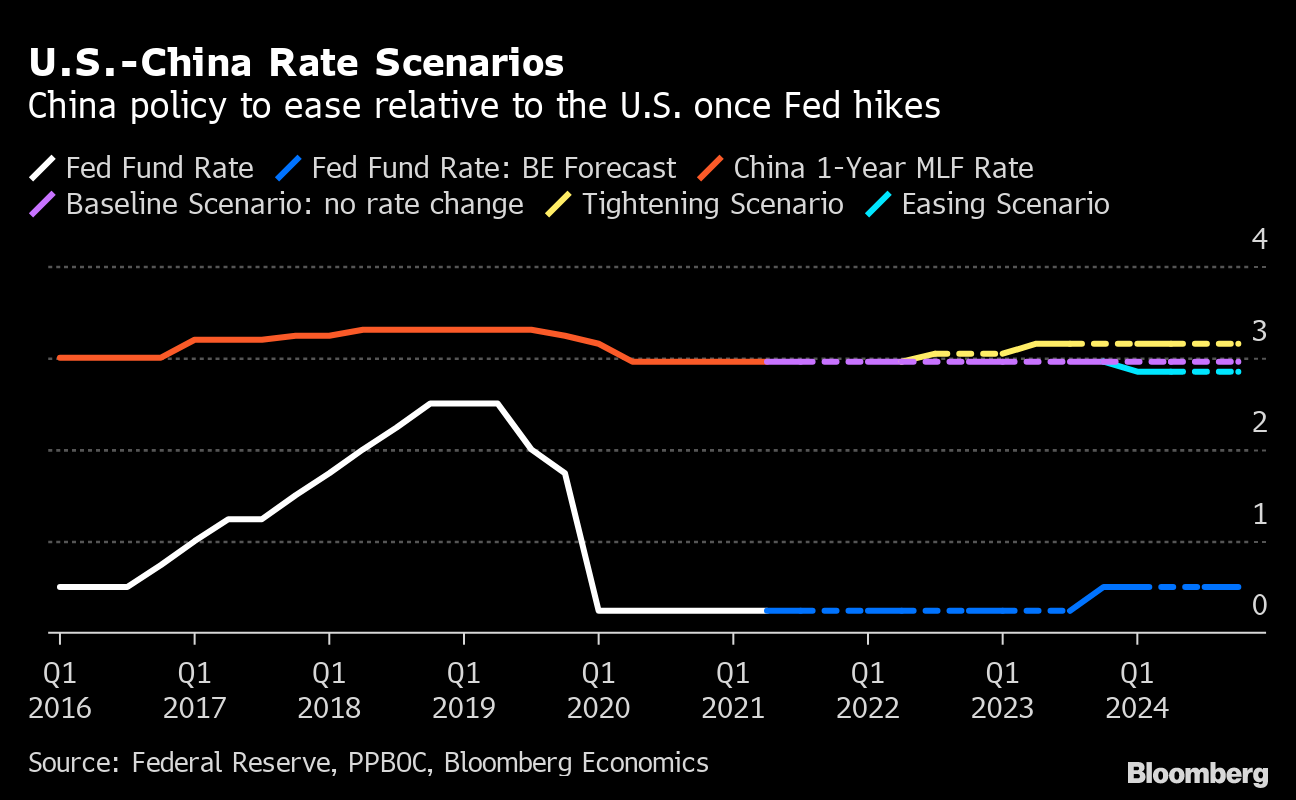
U.S.-China Rate Scenarios

China policy to ease relative to the U.S. once Fed hikes

Source: Federal Reserve, PPBOC, Bloomberg Economics

The Federal Reserve’s interest rate liftoff is unlikely to affect the People’s Bank of China’s policy calculus much, according to Bloomberg Economics.

Emerging Markets

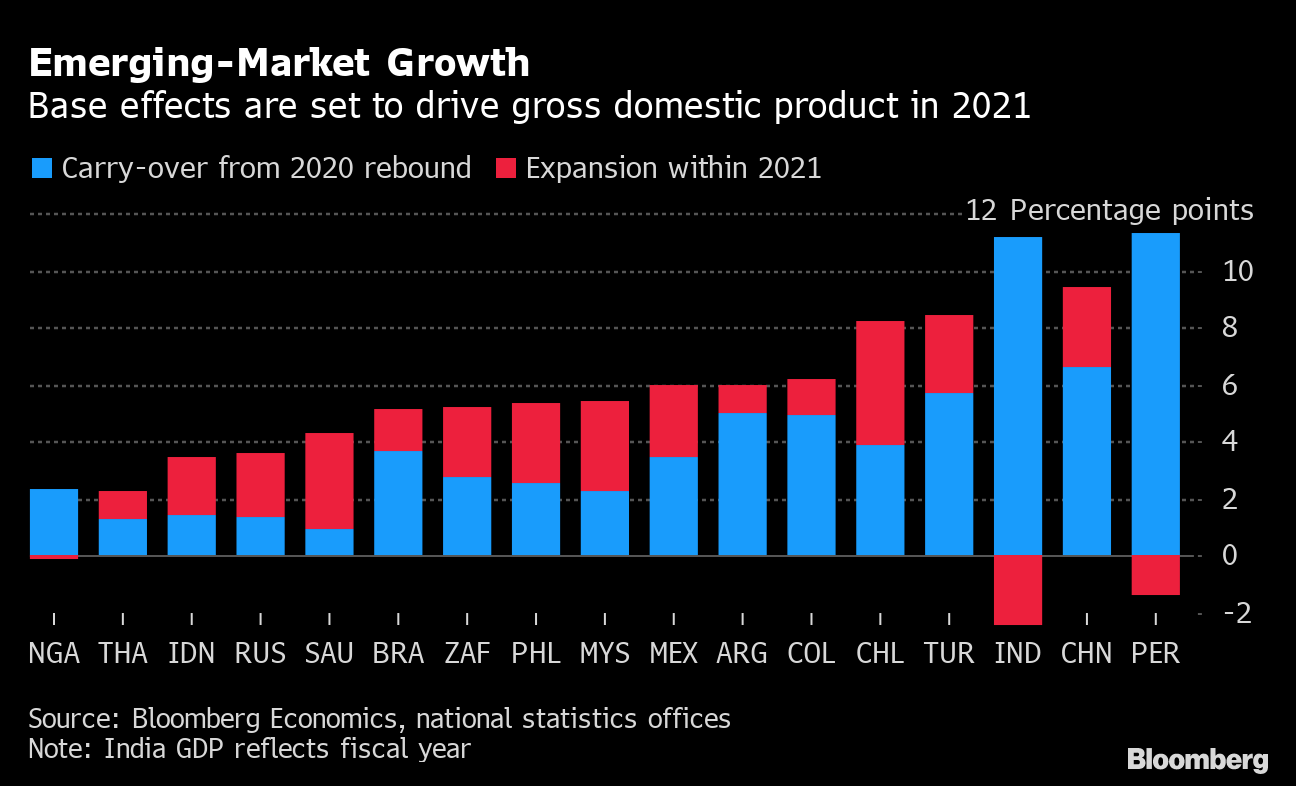
Emerging-Market Growth

Base effects are set to drive gross domestic product in 2021

Source: Bloomberg Economics, national statistics offices

Note: India GDP reflects fiscal year

Taken together, major emerging-market economies have already surpassed their pre-virus peak. Individually, they’re recovering at different speeds, depending on virus containment, trade, commodities, capital flight, and a low base of comparison with the pandemic recession. Bloomberg Economics expects gross domestic product in major emerging markets to expand 8% in aggregate this year after contracting 1.1% in 2020.

Mexico's remittance figures blew past the previous March record

Mexican workers abroad sent more money home than ever as growth and tight labor conditions in the U.S. boost spending power.

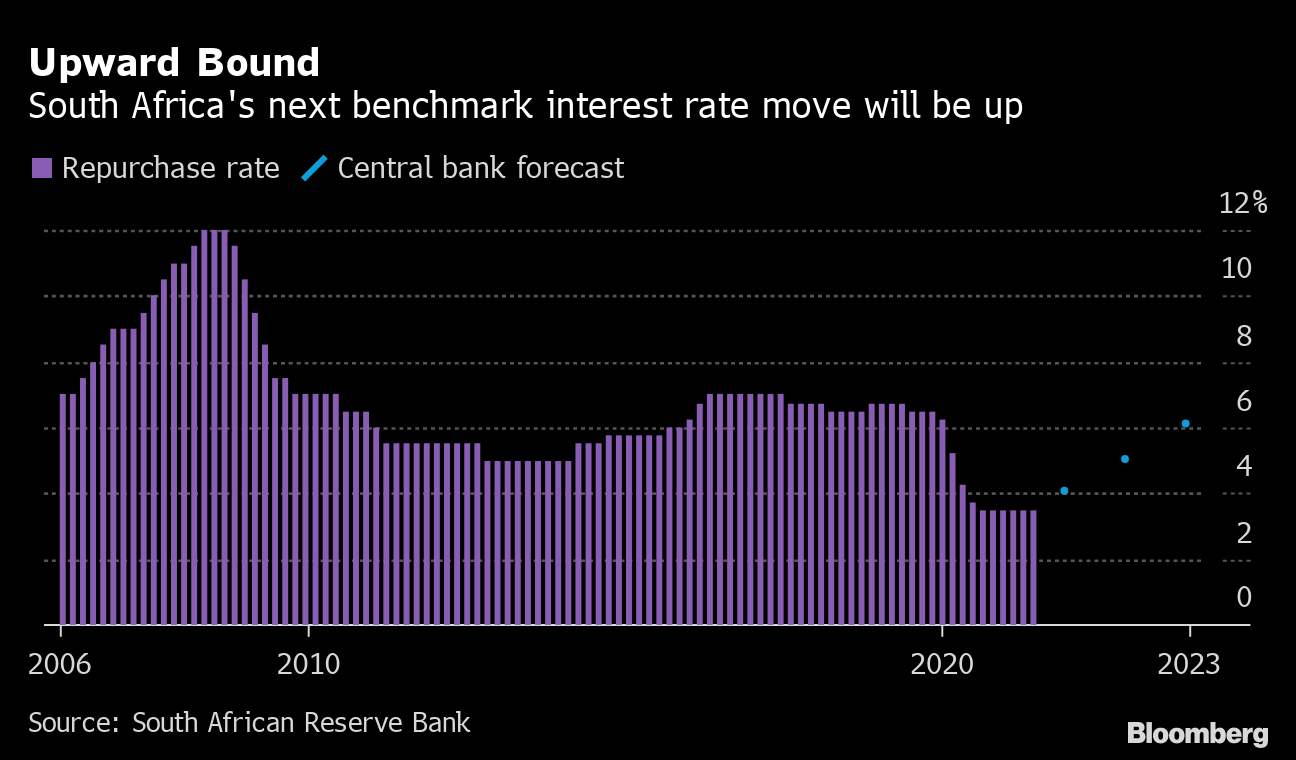
Upward Bound

South Africa's next benchmark interest rate move will be up

Source: South African Reserve Bank

Africa’s oldest central bank celebrated its centenary this week just as it started -- steering South Africa through an economic crisis. Policy makers cut the key interest rate by three percentage points in 2020, of which 275 basis points of easing was in response to the impact of the virus on the economy, taking it to a record low 3.5%. The central bank’s quarterly projection model, which the MPC uses as a guide, indicates two rate increases this year of 25 basis points each and a key rate of 6.11% in 2023.

World

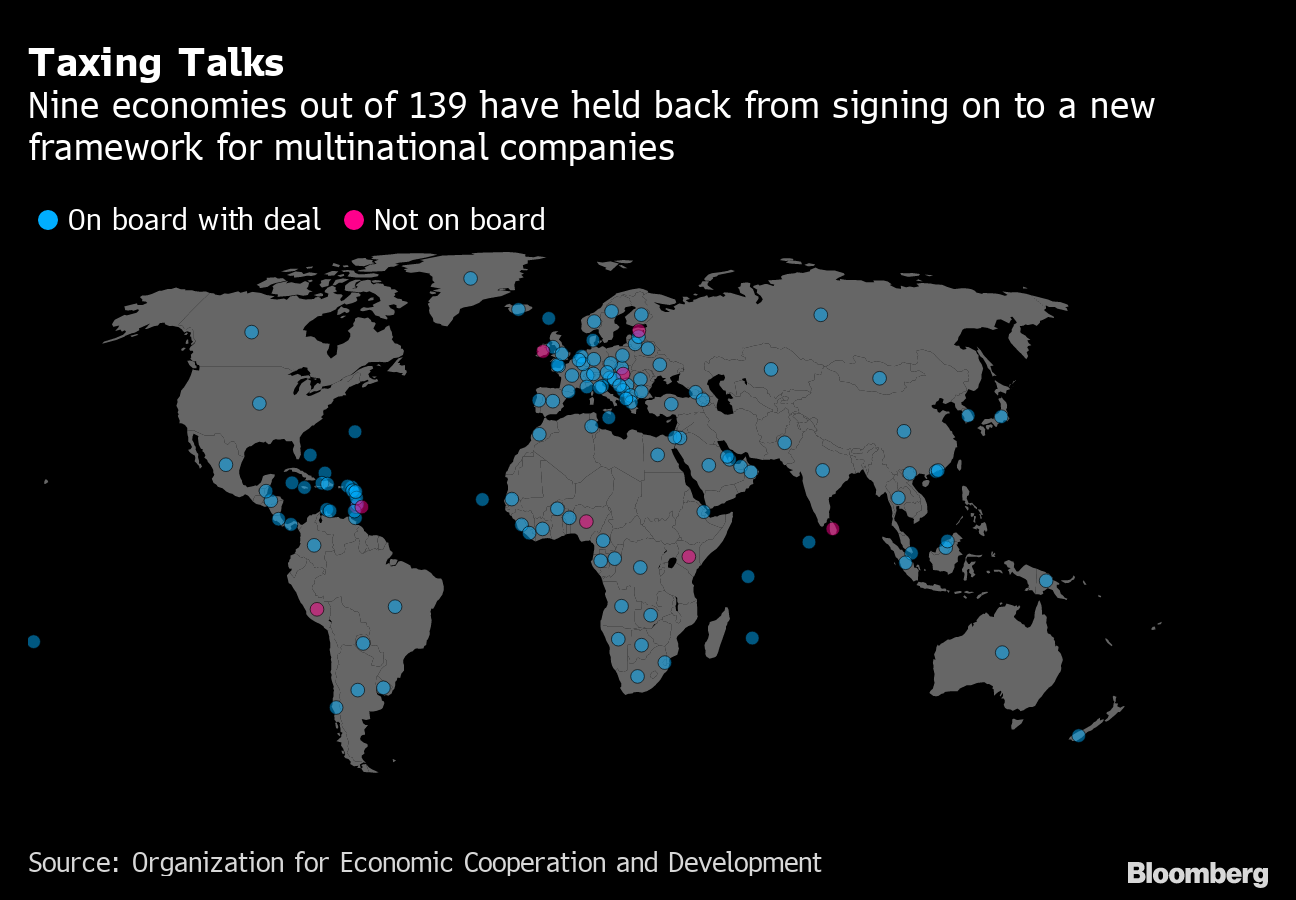
Taxing Talks

Nine economies out of 139 have held back from signing on to a new framework for multinational companies

Source: Organization for Economic Cooperation and Development

The Biden administration and global allies scored a major victory this week in their push for a more balanced international corporate tax system, but still face multiple significant obstacles to completing an ambitious plan that has been years in the making.

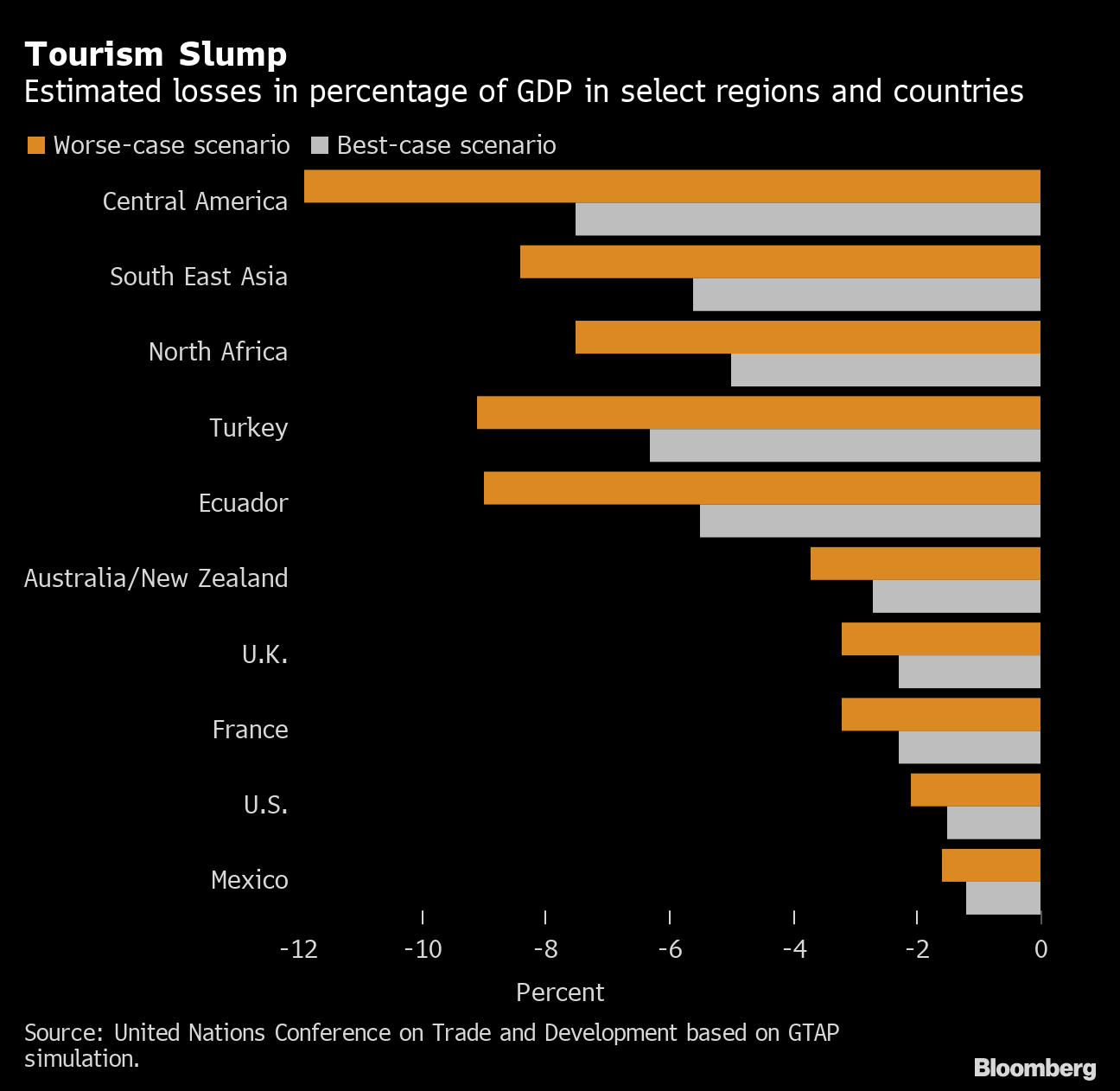
Tourism Slump

Estimated losses in percentage of GDP in select regions and countries

Source: United Nations Conference on Trade and Development based on GTAP simulation.

The slump in tourism caused by Covid-19 will cost the global economy more than $4 trillion for 2020 and 2021, much worse than anticipated, as an uneven vaccination rollout crushes developing countries that are highly dependent on international visitors.

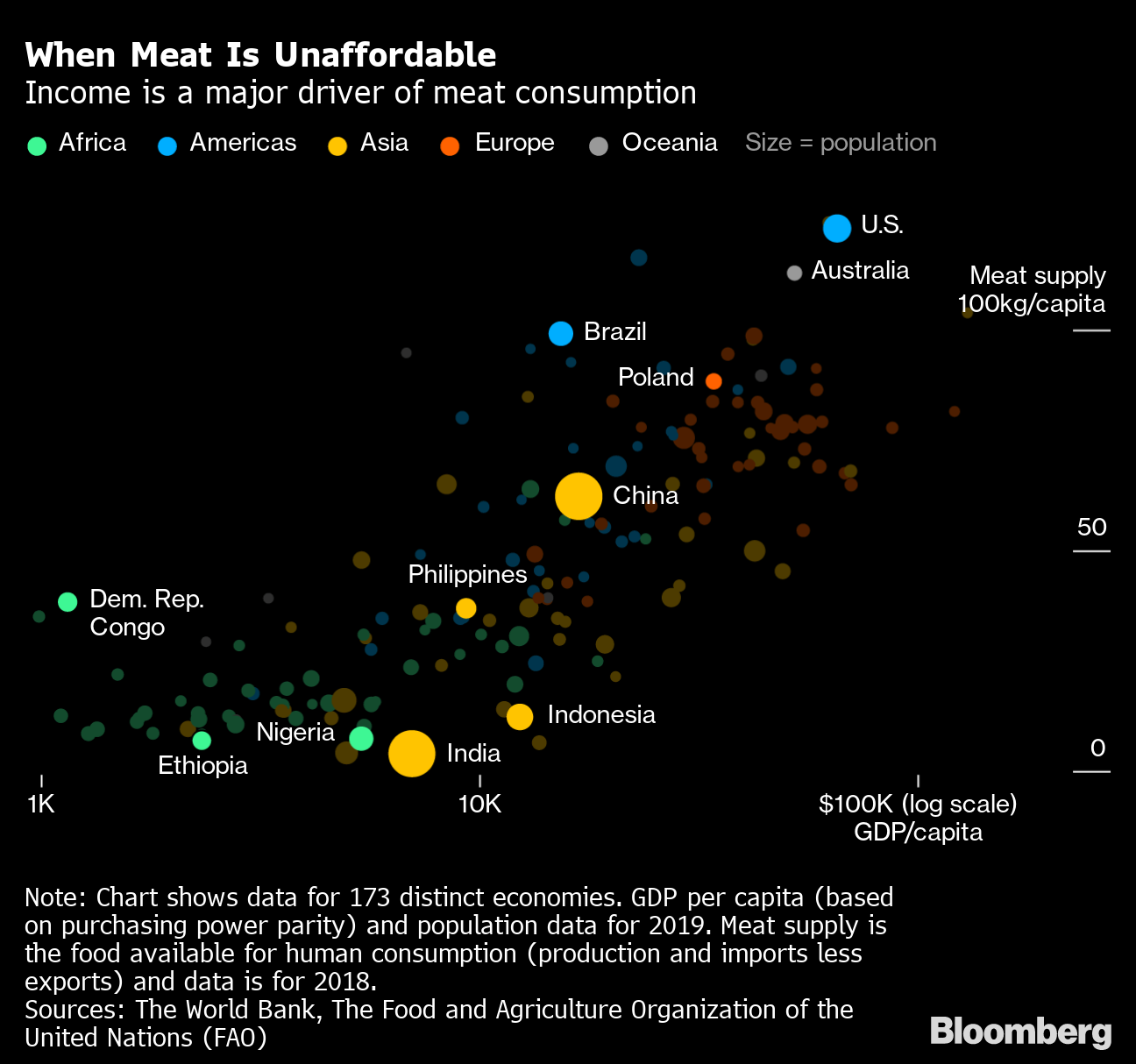
When Meat Is Unaffordable

Income is a major driver of meat consumption

Note: Chart shows data for 173 distinct economies. GDP per capita (based on purchasing power parity) and population data for 2019. Meat supply is the food available for human consumption (production and imports less exports) and data is for 2018.

Sources: The World Bank, The Food and Agriculture Organization of the United Nations (FAO)

A jump in meat prices is forcing families from Brazil to the Philippines to buy less just as a broader move to plant-based eating is gaining traction.

— With assistance by Ziad Daoud, Scott Johnson, Chang Shu, Sophie Caronello, Christopher Condon, Marc Daniel Davies, Jeremy Diamond, Peyton Forte, Jonathan Gilbert, William Horobin, Prinesha Naidoo, Daniela Sirtori-Cortina, Agnieszka de Sousa, Justin Villamil, and Alexander Weber

    Adblock test (Why?)


    Charting the Global Economy: Job Market in U.S. Gains Steam - Bloomberg
    Read More

    Carney touts B.C. port expansion plan to strengthen independence, diversify economy - Toronto Star

    [unable to retrieve full-text content] Carney touts B.C. port expansion plan to strengthen independence, diversify economy    Toronto Star ...