Hello. Today we look at what U.S. banks are saying, the events of the coming week and how low interest rates fuel the rise of superstar firms.
Got to Wear Shades
It was a rip-roaring quarter, and the future is looking bright even amid a welter of risks facing the U.S. economy. That’s the essential takeaway from the earnings from the biggest American banks late last week.
Wall Street is very different from Main Street, but with their tens of millions of individual customers across the country, and business with companies both big and small, they do have a proverbial finger on the pulse of the economy.
Here are some takeaways from the slew of reports and public comments:
Overall Growth
- “Hopefully a year from now, there will be no supply chain problem. The pandemic will become endemic and I think it’s very good to have good healthy growth, which we have. And I think it's good to have unemployment at 4%, it’s good that their jobs are open, I think it’s good the wages are going up along,” said JPMorgan Chase CEO Jamie Dimon.
- “We are likely past the worst of the pandemic’s effects on the global economy,” said Goldman Sachs CEO David Solomon.
- “Growth has come off the boil a tad. We are watching three things very closely: a slowdown in China and its impact on global growth, inflation and supply constraints in labor, materials and energy and finally, what happens next with the U.S. debt-ceiling negotiations. These are also the issues which repeatedly surface in our conversations with clients,” said Citigroup CEO Jane Fraser.
State of Consumer
- Bank of America’s credit card tracker signaled it has turned a corner. Average outstanding balances were up about 3% in the third quarter from the previous three months. That’s the first quarter-over-quarter gain since before the pandemic.
- Wells Fargo saw credit-card revenue climb 4%, which the bank attributed in part to more spending on its cards. Credit card balances grew for the first time since the fourth quarter of 2020.
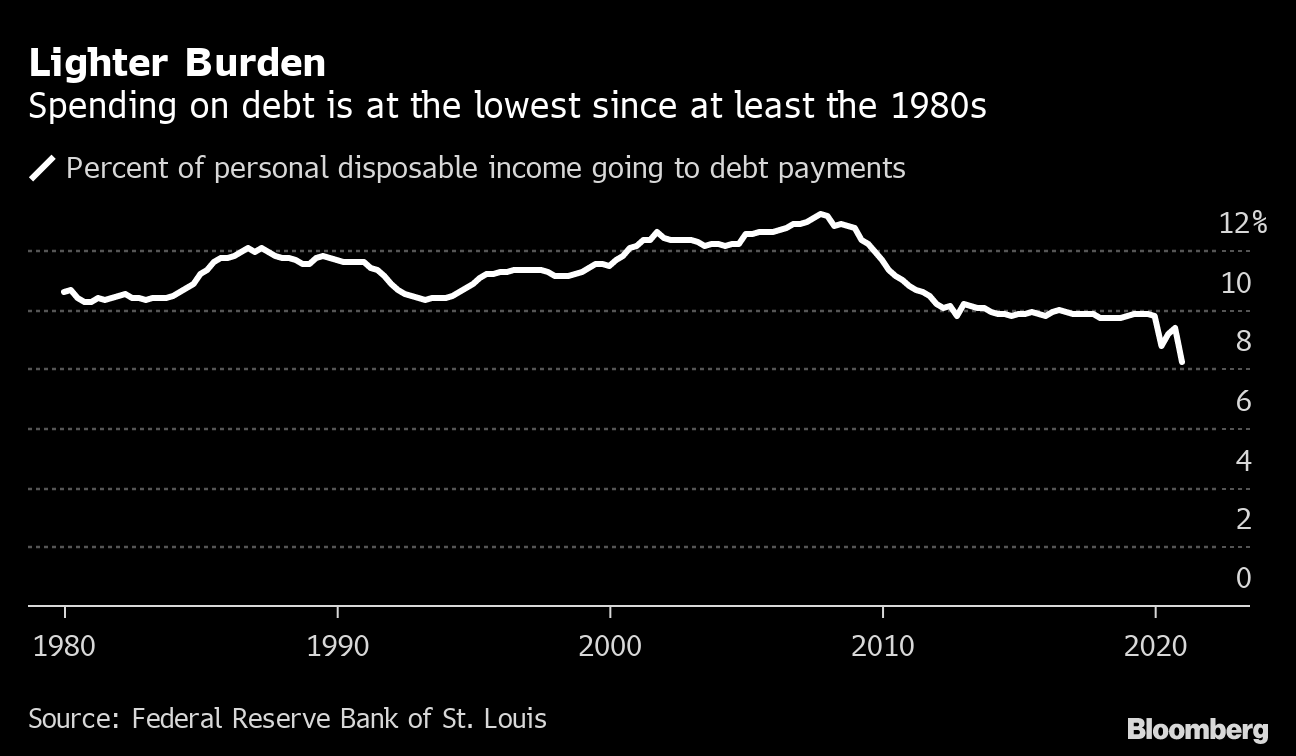
- Citigroup’s Fraser said consumer balance sheets remain “unusually strong.” For more on that score, see Jill Shah’s reporting on household finances in a story out today.
Lighter Burden
Spending on debt is at the lowest since at least the 1980s
Source: Federal Reserve Bank of St. Louis
Business Lending
Growth among the big banks was propelled by investment banking and trading activities, rather than from core lending. Credit to businesses showed a mixed bag:
- JPMorgan’s commercial and industrial loans were down 3%, although they rose 1% when excluding paycheck protection program credit, a government-supported initiative during the pandemic.
- Bank of America’s ex-PPP loans were up 9%, Evercore ISI analysts highlighted.
Inflation
- “Inflation in general is running at a much higher pace than we thought it would be just a few months ago and certainly it’s going to be there a little bit longer. We are seeing a little bit of pressure in wages but not across the board — really only in certain pockets of the company,” said Wells Fargo CFO Mike Santomassimo.
- “Inflation is clearly not temporary,” said Bank of America CEO Brian Moynihan.
- “You have inflation, it’s 4%. It's been 4% now for the better part of a couple of quarters and it's in my view unlikely to be lower than that next quarter or the quarter after that,” said JPMorgan’s Dimon. Still, “people are always focusing too much on immediate concerns. If you have inflation of 4% or 5%, we're still going to open deposit accounts, checking accounts and grow our business.”
Further to that last note by Dimon, consider the view of the Federal Reserve’s army of more than 400 Ph.D. economists on inflation.
Fed staff are predicting that inflation will be back under 2% in 2022, buying into the view that price pressures will be transitory, Steve Matthews reports.
And that’s a view worth considering: Fed staff forecasts historically bettered Wall Street consensus forecasts, Steve shows here.
The Week Ahead
China got the week in economics going with a downbeat third quarter growth report that showed the effect a power crunch and property slump are having. GDP expanded 4.9% from a year earlier, the National Bureau of Statistics said Monday, down from 7.9% in the previous three months.
Industrial output missed estimates for September and investment slowed, bur retail sales did manage to beat economists’ estimates. The upshot is that the world’s second biggest economy is set to slow further.

Elsewhere, Turkey may cut interest rates while Russia raises them, a new reading of U.K. inflation will keep focus on the Bank of England’s possible response, and the Federal Reserve will release its Beige Book.
Click here for our wrap of what’s coming up in the global economy.
Today’s Must Reads
- Calming words | People’s Bank of China Governor Yi Gang said authorities can contain risks posed to the Chinese economy and financial system from the struggles of China Evergrande. The use of “contained” may sound familiar to those who remember 2008.
- Hawkish signal | Bank of England Governor Andrew Bailey moved to strengthen the case for raising interest rates, saying the central bank will “have to act” to curb inflationary forces. That’s even as economists grow increasingly pessimistic about the outlook for the U.K. recovery.
- Global gridlock | Ports are growing more congested as the pandemic era’s supply shocks intensify, threatening to spoil the holiday shopping season, erode corporate profits and drive up consumer prices. Here’s a look at what those stuck aboard are up to.

- Inflation surge | New Zealand inflation surged at the fastest pace in 10 years in the third quarter, reinforcing bets that the central bank there will keep raising rates.
- Team Transitory | As for the Philippines, central bank Governor Benjamin Diokno said he’s with “team transitory” and that it’s more prudent for the country to delay monetary tightening. Among those also in that camp is European Central Bank President Christine Lagarde, who said on Saturday the current spike in inflation is unlikely to last.
- Socking it away | Consumers in Europe and the U.S. aren’t rushing to spend more than $2.7 trillion in savings saved during the pandemic, dashing hopes for a consumption-fueled boost to economic growth.

Need-to-Know Research
Low interest rates are contributing to the rise of so-called superstar companies, according to new research from economists including Atif Mian and Amir Sufi.
The paper, circulated on Monday by the National Bureau for Economic Research, uses data on companies’ financials and monetary policy shocks to find that falling rates disproportionately benefit industry leaders, especially when rates are already low.
That’s because the cost of borrowing falls more for industry leaders; big companies are able to raise more debt, increase leverage, and buy back more shares; and capital investment and acquisitions increase more for those who dominate sectors.
“All three of these effects also snowball as the interest rate approaches zero,” the authors said. “The findings provide empirical support to the idea that extremely low interest rates and the rise of superstar firms are connected.”
Read the full research here.
On #EconTwitter
TV’s “Succession” is back and the Top 1% are still getting wealthier...

Read more reactions on Twitter
Enjoy reading the New Economy Daily?
- Click here for more economic stories
- Tune into the Stephanomics podcast
- Subscribe here for our daily Supply Lines newsletter, here for our weekly Beyond Brexit newsletter
- Follow us @economics
The fourth annual Bloomberg New Economy Forum will convene the world’s most influential leaders in Singapore on Nov. 16-19 to mobilize behind the effort to build a sustainable and inclusive global economy. Learn more here.
What's Happening in the World Economy: Wall Street is Bullish on the US - Bloomberg
Read More


No comments:
Post a Comment