Profits at Alphabet dropped nearly 30% to $13.9bn in the quarter, as YouTube ad revenues declined for the first time since the firm started to report them publicly.
Sales growth at the firm has slowed for five consecutive quarters.
Boss Sundar Pichari said that Alphabet was "sharpening" its focus and "being responsive to the economic environment".
"When Google stumbles, it's a bad omen for digital advertising at large," said Evelyn Mitchell, principal analyst at Insider Intelligence, noting that Google's core website has in the past been more resilient to ad spending downturns than social media sites like Facebook or Snap.
"This disappointing quarter for Google signifies hard times ahead if market conditions continue to deteriorate."
Microsoft said it expected demand for its PC and cloud computing technology to continue falling this year as business customers cut back.
Sales in its Xbox video game business have also slumped.
Big tech firms saw their sales jump in the pandemic as locked-down consumers and workers came to rely more on their technology. But the sector's fortunes look bleaker in the current climate.
In recent months, Alphabet has said it was slowing hiring, while Microsoft has cut jobs.
Many other tech companies have decided to lay off staff, including Netflix and Twitter, or slow the pace of recruitment, such as social media platform Snap.
Shares in both Alphabet and Microsoft fell sharply in after-hours trading on Tuesday.
This is an edition of The Atlantic Daily, a newsletter that guides you through the biggest stories of the day, helps you discover new ideas, and recommends the best in culture.Sign up for it here.
The races in the midterm are tightening up, but everyone who cares about democracy should resist the urge to turn the election into a referendum on inflation.
But first, here are three new stories from The Atlantic.
Last summer, it seemed like the Republicans were going to face a reversal of political gravity, and the Democrats would keep their majority during a first midterm election under a Democratic president. Historically, this is hard to do: Voters, for many reasons, usually trim congressional seats from a first-term president’s party. But the Democrats have benefited from the Republican plunge into extremism. The GOP still refuses to abandon Donald Trump and his violent insurrectionist movement; it is running ghastly candidates; and like a dog chasing a car, it smashed its snout into the bumper of the Supreme Court’s Dobbs v. Jackson Women's Health Organization decision overturning Roe v. Wade, angering millions.
But autumn is here, and Democratic candidates are now struggling against this parade of election deniers, religious bigots, and conspiracy theorists who once would have been beyond the pale of modern American politics. The revelations of January 6, as I wrote earlier this month, seem irrelevant to many voters, some of whom still refuse to believe that anything bad happened on that horrible day. (If the police officer Michael Fanone had a heart attack during the riot, one Pennsylvania voter told MSNBC, he “shouldn’t have been a cop.”)
Some of this is the result of Democratic miscalculations. Abortion rights and Donald Trump were never going to win this election on their own, and though foreign policy is a Democratic bright spot, it does not usually play much as an issue in midterm elections. (That didn’t stop 30 House Democrats from issuing and then retracting a clumsy and pointless letter to Joe Biden this week about seeking negotiations with Russia.) Yes, inflation is high, and Americans always blame the party in power for such indicators. But there is another reason the Democrats could lose to this bizarre parade of otherwise unelectable candidates: The coalition to protect American democracy has failed to present a narrative of what life would look like—politically and economically—if this Republican Party returns to power.
This is a daunting challenge, but it is much harder now that the Republicans have convinced their opponents (especially among the Democrats) to internalize a Republican narrative: that the economy is the only thing voters care about, and that only a change of party can fix it. Ironically, even Republicans aren’t bothering to run on that same narrative, other than to say that Democrats are responsible for all bad things, including inflation. Republicans know their base, and have not bothered to put forward anything like an economic plan. The GOP response to everything is a Gish Gallop of fearful messages about crime and immigration and gun rights and trans people, and for their voters, it works.
Recall, for example, that in Ohio, J. D. Vance early on was trying to run something like a moderate primary campaign—including putting distance between himself and Trump—and found himself losing to an extremist. Vance learned his lesson. He started talking about “degenerate liberals” and accepted Trump’s humiliating embrace. Likewise, it’s not because of gas prices that in Arizona, Kari Lake is running an ad featuring a homophobic and Islamophobic pastor. Doug Mastriano is not running as a Christian nationalist in Pennsylvania because milk is more expensive.
And Herschel Walker and Raphael Warnock are not in a tight race because Georgia voters think that Walker understands the problems of the common folk (unless the problem is men not acknowledging the children they’ve fathered). It is risible to believe that GOP voters are hoping Walker is going to take a seat, say, on the Finance Committee and start proposing solutions for inflation.
But the economy and democratic freedom are related—and the voters are capable of understanding this, if anyone would bother to make the case. Instead of preemptively apologizing for inflation or trying to undermine Biden’s foreign policy, perhaps the Democrats and others supporting a prodemocracy coalition should ask Americans if they’d like their votes nullified and to see the U.S. eventually transformed into a democratically challenged country like Turkey, where an autocratic president cracks down on his opponents and presides over an 83 percent inflation rate. Perhaps they’d like to be Hungary—a country now loved by many on the American right—where democracy is floundering, inflation is 20 percent, and teachers are marching in the streets.
Perhaps those of us who believe democracy is on the ballot could take a page from Ronald Reagan, who in 1980 pummeled Jimmy Carter both on the economy and foreign policy and won. And yet, by 1982, his victory seemed to be in ashes and predictions of a single term were common. The Cold War was frozen solid, people were scared, and the economy was in a brutal recession. Reagan’s answer was not “I feel your pain,” or “It’s the economy, stupid,” but rather: “Stay the course.” He asked the public to stand by him rather than return to the situation they had just left behind.
The need to stay the course is even more important now. Voters concerned about democracy should remind their fellow citizens that a GOP majority will not fix the economy or face down the Russians. Instead, state-level Republicans will issue partisan challenges to our constitutional process while cowardly national Republicans nod their approval. By 2025, Republicans at the state and national level might be able to simply ignore any election result they happen not to like.
To believe that voters can only think of one thing at a time is a remarkably elitist position, especially when Americans have repeatedly proved that they can vote on multiple issues. To reduce everything in 2022 to inflation and gasoline is to demean and infantilize the voters, to treat them as if they are cattle whose only concern is the price of feed. But all of us need to make the case for democracy and prosperity—and to remind ourselves that these blessings cannot exist without each other.
In America, popular narratives about adoption tend to focus on happy endings. Poor mothers who were predestined to give their children away for a “better life”; unwanted kids turned into chosen ones; made-for-television reunions years later. Since childhood, these story lines about the industry of infant adoptions had gradually seeped into my subconscious from movies, books, and the news.
Then, following the Supreme Court decision to overturn Roe v. Wade, the tropes proliferated. Photos of smiling white couples holding signs that read “We will adopt your baby” went viral this summer, quickly inspiring online mockery. Many U.S. adoption agencies prepared for a potential increase in adoption in states that have made abortion illegal, despite limited evidence that a need for these services will increase.
(Bloomberg) -- Mexico’s economy expanded in August at the fastest pace in more than a year driven by services, suggesting domestic activity is more resilient than expected.
Economic activity expanded 5.7% from the previous year, the most since July 2021 and above all forecasts from economists in a Bloomberg survey whose median estimate was for a 3.1% increase. On a monthly basis, activity grew almost 1%, also above expectations, the country’s statistics institute said on Tuesday.
What Bloomberg Economics Says
“The results suggest the central bank has less monetary policy flexibility. Along with high inflation and increasing US interest rates, they support our expectations for Banxico to continue raising rates.”
-- Felipe Hernandez, Latin America economist
-- Click here for the full report
Latin America’s second-largest economy is expected to lose steam later in the year and in 2023 amid higher interest rates and slower growth in the country’s main trading partner. A near-certain US recession next year will likely pull Mexico into a contraction as well, according to Bloomberg Economics.
MEXICO INSIGHT: Model Shows US-Imported Recession in 2023
Like a convertible speeding down the highway, what was a red-hot economy is showing signs of tapping on the brakes.
As pandemic restrictions lifted over the last 12 months, all the pent-up demand for shopping, traveling and overall spending began to spill out — with inflation rising to record levels.
Now, with every passing day, there is more talk about the need for an economic cool-down, which is why a looming recession could be right around the corner.
Finance Minister Chrystia Freeland is already warning of "difficult days ahead" for the economy, while some finance experts suspect there's a 70 per cent chance of a recession and it could happen in early 2023.
All that speculation of a recession sparks painful memories of what many felt in the 1980s and again during the financial crisis about 15 years ago. Those were deep downturns with ripple-effects throughout the country and across businesses big and small.
A recession this time around is not supposed to be nearly as bad, more of a reset or a pause in growth to rein in rampant inflation, supply chain problems, and labour shortages.
Nobody wants a recession, but experts say it might be the medicine that's needed to get back to what people normally expect when they're looking for a job, buying a home, or planning their household monthly budget.
There are many ways to judge the health of the economy and where it's headed, so here's a look at some of the key indicators and what they're showing.
Economy has stalled
At this point, the country's economy is likely no longer growing, but not shrinking either. Instead, it's at an inflection point. A potential calm before the storm clouds roll in.
Unfortunately, the most recent data is from back in July, so it's a bit dated. The economy grew slightly that month, but continued the trend of minimal growth after plenty of momentum during the first half of the year.
Many people are starting to tighten up on how much they spend. Retail spending is up, but that's likely because of inflation. Basically, people aren't buying more, they are just having to pay more for what they purchase.
The latest retail sales figures are for August, which show an increase. Still, economists say retail sales have likely peaked and they see signs that consumers are beginning to pull back on spending in the face of escalating inflation and borrowing costs.
"I'm looking a lot at retail sales," said Charles St-Arnaud, chief economist at Alberta Central, which represents the province's credit unions.
"If we get into a recession, it will come from the consumer side," he said.
Business community pessimistic
Take just one look at how the stock markets have fared this year and you'll quickly know how investors and the business community are feeling about the economy.
Stock markets are responding to all the economic gloom and investors anticipate there's more pain to come.
The TSX is down more than 12 per cent so far this year, while the major U.S. stock markets have lost even more value.
Overall business sentiment has softened, according the a recent Bank of Canada survey, with many companies expecting slower sales growth and a majority say a recession is likely in the next 12 months. Manufacturing activity is falling too.
Amazon founder Jeff Bezos has said it's time to "batten down the hatches," while Goldman Sachs CEO David Solomon said there's "more volatility on the horizon" and a likely recession.
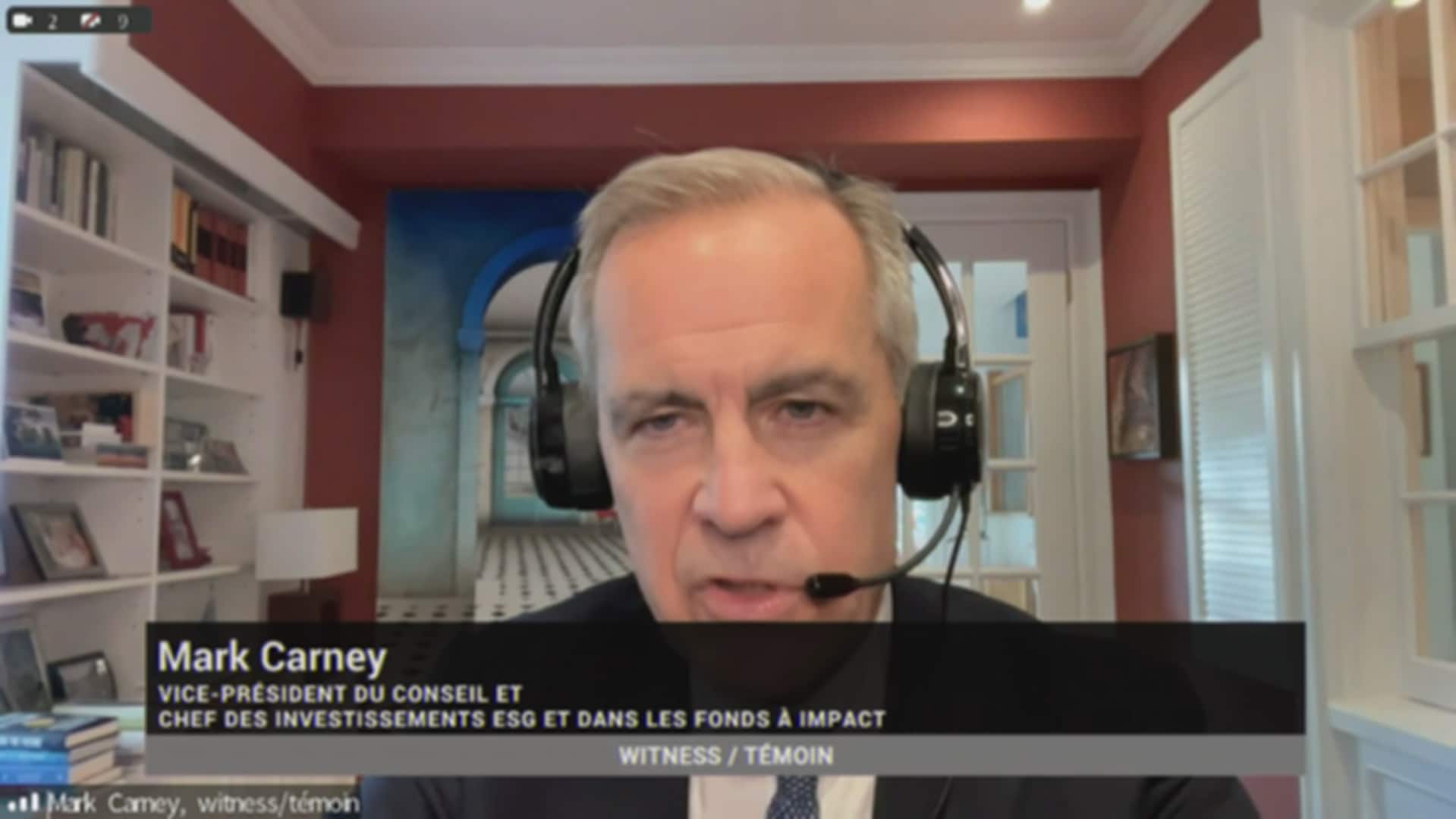
WATCH | Why former Bank of Canada governor Mark Carney thinks a recession is likely:
‘A recession is both likely globally and most probable in Canada,’ says Mark Carney
5 days ago
Duration 1:11
Former Bank of Canada and Bank of England governor Mark Carney told a Senate of Canada committee that Canada likely will head into a recession next year but will fare better than many other countries and bounce back faster.
Help wanted
As a trucking and logistics company, the Mullen Group headquartered in Okotoks, Alta., is having one of its best years since its inception in 1949. As the economy goes, so does the company's fortunes.
While businesses have struggled to find enough workers this year, many have caught up, including the Mullen Group, which is now fully staffed, including enough truck drivers. There's no need to hire more people as the company begins to experience a bit less demand for its services, especially from the retail sector.
"We're seeing cracks, we're seeing some slowdown, we're seeing consumers be a little more cautious right now with their spend," said chief executive Murray Mullen.
"Recessions are a time just to pause and get things back in balance," he said. "Sometimes it's a necessary evil."
The economy can't always keep growing, says Mullen Group CEO Murray Mullen, which is why recessions are sometimes necessary. (Kyle Bakx/CBC)
Canada added 21,000 jobs last month, pushing the jobless rate down to 5.2 per cent.
"We're literally in the tightest labour market we have seen in decades and at the same time prices [are] really high. So you really don't want to have what we call a wage-inflation spiral situation," said George Jia, an associate professor of economics at the University of Prince Edward Island.
Unstable housing market
As mortgage rates have climbed this year, real estate prices have fallen in many parts of the country.
In fact, both sales and average prices have tumbled.
Average selling prices are down more than 20 per cent from an all-time high in February, and down 6.6 per cent since last year. The number of sales are down by more than 30 per cent compared to one year ago.
"Canada's economy has been driven partially by the housing market boom for awhile now," said Jia, who recommends people pay attention to the overall health of the industry, beyond real estate figures.
The housing market boom has helped propel Canada's economy, which is why UPEI economist George Jia is paying attention to the housing construction industry as he gauges the health of the economy. (George Jia)
After a surge in construction in 2021, housing starts are down about five per cent in the six largest cities during the first half of this year.
Like the stock market, the state of the housing market can often indicate the direction the economy is headed.
Staying afloat
It seems every month, people are getting squeezed even more. As the cost of living has increased, including grocery store prices and mortgages, some people aren't able pay their bills.
The number of insolvencies remain quite low, but they are rising and there are other signs of continued problems.
In recent months, there has been a sharp rise in the number of consumer proposals — a renegotiation with creditors to repay debts — which suggests a rise in households struggling with managing their debt.
It's no secret many people are taking a financial hit to their wallet mainly because of inflation and rising borrowing costs. Considering the high levels of household debt in the country, some experts anticipate the bankruptcy rates to keep marching up.
Canada's economy has basically stalled, says Charles St-Arnaud, chief economist at Alberta Central. (Kyle Bakx/CBC)
For St-Arnaud, with Alberta Central, the question is whether the strong job market and the massive amount of savings accumulated during the pandemic, which he estimates at $320 billion, will provide some relief to financial challenges many are facing.
"We're already starting to see households reduce their level of savings to keep their level of spending," he said. "If there is a big increase in the unemployment rate, then more households will run into more problems."
WATCH | Threat of recession looms in Canada:
Canada faces economic trouble in months ahead: International Monetary Fund
1 day ago
Duration 2:32
The chief economist of the International Monetary Fund is warning that Canada faces economic challenges in the months ahead as concerns loom about a potential recession.
(Bloomberg) -- As Rishi Sunak becomes the UK’s third Conservative prime minister within just four months, the role is increasingly looking like a poisoned chalice.
His victory on Monday puts him in charge of an unenviable cocktail of problems including a struggling economy, a long-running energy squeeze and a divided party that’s slumped in the polls.
Gilts rallied on Monday on the news, pushing the 10-year yield to the lowest in almost three weeks, a sign that market confidence could be rebuilt under Sunak’s premiership. But any policy action will be closely watched by a market that has lost faith in the government and is highly sensitive to fiscal change.
In his first public comments as leader, Sunak called on his party to unite to deal with a “profound economic challenge.” Here’s a list of the many tests that face the newest occupier of No. 10 Downing Street:
Economy:
Sunak takes the reins against a recessionary backdrop and inflation running at a double-digit pace. Surveys on Monday showed private-sector activity shrank in October, another round of bad numbers after weak retail sales last week.
Meanwhile, households are struggling amid a worsening cost-of-living crisis. As prices for goods and services surge more quickly than wages, workers and families are left with less money to spend. Real earnings are down almost 3% in the past year.
Sunak also needs to tread carefully with fiscal measures to avoid detonating another dramatic reaction in the gilt market. The recent market turmoil in the wake of his predecessor’s tax giveaway sent bond yields jumping, with implications for borrowing costs not just for the government, but households and businesses too.
Energy Crisis:
Persistently high energy prices spurred by Russia’s invasion of Ukraine will present a problem to both businesses and households when government support runs out in April 2023.
If prices don’t decline by then, or an alternative energy support package is not put in place, inflation could reach 15% or higher, according to some forecasts. Household energy bills could increase twofold, putting further pressure on incomes at a time the economy is stuck in a recession.
Housing Market:
The relentless rise in mortgage costs is one of the headaches that Sunak will inherit upon taking office. It’s already having an effect on the property market, where demand is slowing sharply and price growth has cooled, particularly in London.
Higher mortgage rates will also squeeze those looking to refinance in the coming year, and Sunak will be under pressure to ease the burden given many households are already under strain from rising energy costs and soaring inflation.
Public Services:
Chronic underfunding and a growing malaise among civil servants and public-sector workers make spending cuts controversial, limiting Sunak’s political headroom.
The UK already saw a wave of strikes throughout the summer -- adding to a picture of “broken Britain” -- as workers pushed back against below-inflation wage rises.
Recent signals the government will have to push through an austerity program and cut spending has already led to calls from trade unions to protest against any such measures. Sunak will need to balance the need for budget cuts against the risk of sparking more industrial action over the winter, as well as giving the opposition Labour Party another stick to use against the government.
Healthcare:
Overflowing hospitals and long ambulance waits have become the norm in the UK, and the expected winter surge in hospital admissions threatens to overwhelm health services already stricken with underfunding and staff shortages.
The removal of the Health and Social Care levy cuts £13 billion of additional funding for the National Health Service that might have gone toward improving social care to free up hospital beds. That’s money, or savings, that will have to be found elsewhere in the budget.
On top of all that, NHS staff are seeing their wages eroded by rising inflation, and are threatening strike action over pay.
Pensions and Benefits:
With inflation above 10% and still yet to peak, the government is under pressure to raise benefit payments in line with inflation and uphold the so-called triple lock formula on pensions. It dictates that payments rise in line with inflation, earnings growth, or 2.5%, whichever is the highest.
If uprated in line with inflation, welfare spending could reach £277 billion, around half of which being pensions, hitting the budget hard at a time when fiscal headroom is already scarce.
Brexit:
Brexit remains a thorn in the side of the Conservative Party, with the new premier under pressure to deliver on new trade deals and growth.
The Northern Ireland protocol -- which removes the need for a hard border with the Republic of Ireland by keeping the region in the European single market for goods -- is a particular sticking point, with businesses pushing back against the increased red tape and costs associated with the new arrangement.
Banking Tax:
Uncertainty rankles banks around whether a planned cut in the banking surcharge from 8% to 3% will still take place under Sunak’s leadership. Amid a squeeze on spending, the government can little afford to lose more income to the Treasury coffers.
Banks claim the cut is needed to keep London competitive against other financial centers, with analysis from PwC stating that alongside corporation and other employment taxes, UK banks may pay a higher rate than any financial center that competes with London. Chancellor Jeremy Hunt, who is likely to keep his position, hasn’t quelled speculation about the tax, saying he’ll wait to address the issue during his fiscal statement on Oct. 31.
Party Divisions:
And finally, though importantly, Sunak will be tasked with uniting a Conservative Party that is now bitterly divided by infighting, failed leaderships and deep ideological differences. Any hope of competing against Labour at the next general election in 2024 will depend on rebuilding bridges within the party.
He also risks political impotency if he doesn’t succeed in uniting the Tories behind his political agenda. The specter of former Prime Minister Boris Johnson still lingers on, with some Johnson loyalists still blaming Sunak for his downfall. Sunak said Monday in his short address that “stability and unity” were needed to get through the current difficulties.
Read More: Feuds and Loathing in Westminster Will Haunt Next Tory Leader
To take the temperature of the local economy, Lloydminster Mayor Gerald Aalbers only needs to look out the window.
From his office at City Hall, Aalbers — who, because Lloydminster straddles the Alberta-Saskatchewan boundary, has the unique distinction of serving residents in two provinces — has a direct line of sight to Highway 16. The highway is a major east-west corridor frequented by heavy-haul trucks and half-tons on their way to the oilfields that dot the surrounding region.
But in spite of 2022’s sharp uptick in crude prices (hitting as high as US$120 per barrel earlier this year before declining to the mid-$80 range this fall), and even as Canadian oil companies boast record revenues and all-time high production levels, the volume of traffic along the highway has only moderately increased, Aalbers said.
“We’re seeing traffic pick up earlier in the morning and a little more traffic throughout the city,” Aalbers said.
“That’s good, because it means wells are being drilled. It reflects some general optimism in the industry,” he added. “So I think we’re hitting some speed, but we’re not accelerating yet by any means.”
“Not accelerating yet” may be the perfect way to describe the odd economic reality Canada’s oil country finds itself in in 2022.
While the industry itself is faring better than it has in almost a decade, with energy prices higher than they’ve been in many years, experts say any kind of resulting economic explosion for the surrounding region has been conspicuously absent.
“If I would have told you two years ago that oil revenues in Alberta would be reaching record highs … you would have expected that Calgary and Edmonton would be booming, and the rest of the province too. And it’s not happening,” said Charles St-Arnaud, chief economist for Alberta Central, the central banking facility for the province’s credit unions.
In 2014, for example, the last time oil prices boomed, many communities in Alberta and to a lesser extent Saskatchewan felt like gold rush towns. Hotel rooms were booked solid, local bars buzzed with oilfield workers flush with cash and swagger, and people from all across the country streamed west in search of jobs.
But St-Arnaud, who recently published a report titled “Where’s the Boom?” said many things are different this time around.
The industry itself is doing very well — total oil production in Alberta hit an all-time record in the first half of 2022, averaging 3.6 million barrels per day.
And thanks to sky-high commodity prices, the total value of the province’s oil production between August 2021 and August 2022 was a whopping $140 billion, 75 per cent higher than the same period in 2014. In the first six months of this year, Canada’s four biggest oilsands producers alone reported more than $21 billion in profits, more than three times their profits in the same period last year.
But after almost a decade of depressed oil prices, producers have been under pressure in 2022 to use their extraordinary profits to pay down debt and focus on returns to shareholders rather than investing in their operations.
In 2022, oil producers reinvested only about seven per cent of revenues into their operations, compared to 25 per cent in 2014, St-Arnaud said. The nature of those investments has also changed, as companies forego capital-intensive projects aimed at boosting production in favour of smaller projects intended to improve efficiencies or lower greenhouse gas emissions.
The result is fewer workers and fewer economic spinoff effects. According to Statistics Canada, total employment in Alberta’s oil and gas sector is only 75 per cent what it was in 2014, while employment in construction, a spinoff sector, is only 80 per cent what it was then.
Similarly, wages in the oilpatch no longer outpace other sectors the way they once did, St-Arnaud said.
“You don’t need to offer sky-high salaries to attract workers, because you don’t need as many workers,” he said. “One of the things I’ve been noticing is we used to have wages in Alberta that were about 10 per cent higher than the rest of Canada – consistently, since the late 2000s. But the gap has been starting to narrow over the past few years.”
Duane Sulyma, a rigger who has worked everywhere from Grande Prairie and Rocky Mountain House, Alta. to Lloydminster and now Kindersley, Sask., said an oilfield job isn’t as lucrative as it once was, and workers are feeling the pinch of inflation.
“When I started in 2012, it was wild. I bought a new house, I bought a truck, I bought everything I ever wanted,” Sulyma said. “But the numbers don’t add up anymore, and the cost of living has gone through the roof.”
He added after the past eight years of low commodity prices and then the COVID-19 pandemic, many former oilfield workers have had enough of the volatility and have chosen to leave the oil and gas industry altogether.
“Nobody who has a town job wants to come out here, work for a year, get laid off and then have to struggle to find another town job,” Sulyma said.
St-Arnaud is convinced that the oil industry has changed permanently. And while that may bring with it some downsides, it also means that going forward, Alberta’s economy will be less sensitive to oil prices.
“That’s the thing, if there’s no boom — the bust will be smaller,” he said. “It’s not that oil is no longer a positive to our economy, it’s just not as positive as it was.”
That’s not necessarily a bad thing, said Sandy Bowman, mayor of the rural municipality of Wood Buffalo, which incorporates the oilsands community of Fort McMurray.
As Canada’s most well-known boomtown, Fort McMurray struggled in the 2010-2014 period to keep up with demand for housing, roads and other infrastructure as workers flooded into the community from across the country.
“Strong, steady growth is what you want to see. Those booms and busts we’ve experienced can be hard on everyone – not just the workers, but the community itself,” Bowman said.
Even getting a coffee from the Tim Horton’s drive-thru in Fort McMurray would take close to 20 minutes on average back then, Bowman said. Now, getting a double-double takes just 11 minutes “on a bad day,” he said.
While a major airport expansion completed in 2014 remains “under-utilized,” and the buzz of saws and other construction noises have lessened, Bowman said Fort McMurray’s economy in 2022 is healthy. Local residents are working and collecting paycheques, and life goes on.
“There’s still a lot of opportunity and there’s a lot of ‘help wanted’ signs around … the industry is just not expanding the way it was before,” Bowman said.