Rechercher dans ce blog

Monday, April 3, 2023

Dollar's slide on rate-cut bets nearing limit as economic stress coming up short By Investing.com - Investing.com

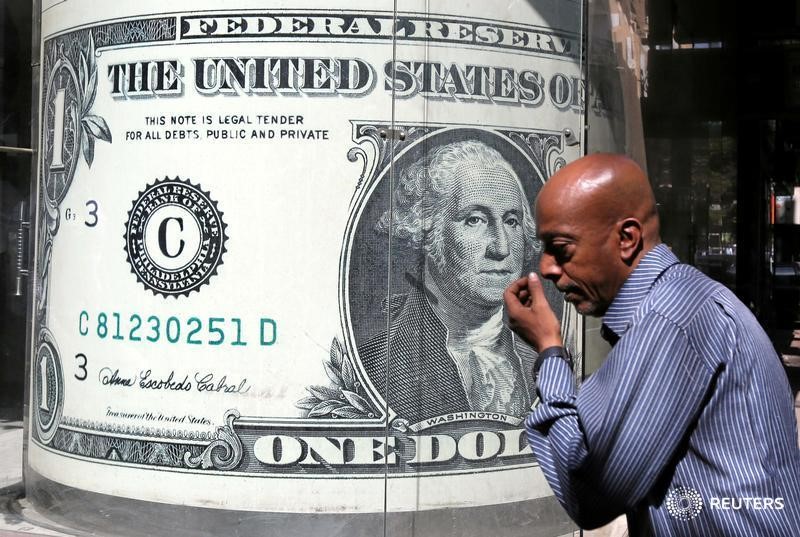
Dollar’s slide on rate-cut bets nearing limit as economic stress coming up short © Reuters.

By Yasin Ebrahim

Investing.com – The dollar bears have been beating the Federal Reserve rate-cut drum, dragging the greenback lower but that tune may soon be out of rhythm should the economic impact from the banking crisis remain modest.

The , which measures the greenback against a trade-weighted basket of six major currencies, fell by 0.45% to 101.72.

More evidence pointing to economic stress and tightening in lending conditions -- following the banking crisis -- is needed to justify pricing in further dollar weakness on expectations for a less hawkish Fed, Goldman Sachs said.

"We think we are approaching the limit on the amount of dollar weakness that can be priced on the back of policy divergence," Goldman Sachs said, adding that "clear evidence" was needed to justify the growing bets on a Fed pivot at a time when banking crisis appears to be under control.

Growing bets on a cut have pushed the federal funds rate more than 100 basis points lower than before the bank failures, according to Goldman Sachs. The bets on a Fed pivot reflect the market's view that "the tightening in credit conditions will do the Fed's job so that they no longer have to raise rates much further to make them more confident that inflation will fall back to their target," MUFG said in a note. 

At his monetary policy press conference in March, Fed chairman Jerome Powell said tighter lending conditions could be a substitute for rate hikes, though added that if the level of tightening was less than expected, then the central bank may continue to pursue a higher for longer rate regime.

But the tightening from what has transpired so far doesn't "appear to be large enough to provide the amount of restraint the market is pricing," according to Goldman Sachs. Recent Fed balance sheet showing that banks reduced borrowing from the Fed's lending program gives credence to that view. 

"[F]ears over the health of US regional banks will have been eased by the release of latest balance sheet data that revealed a reduction in the usage of liquidity windows to support banks," MUFG added. 

Others suggest that while it may be too soon to fully gauge the impact on bank lending standards from the recent bank failures, signs of diminishing deposits in the banking sector point to reduce lending that will eventually push the economy into recession and force the Fed to launch a rescue mission.

"The recession will drive inflation down more quickly than policymakers expect, so we expect the Fed to respond by cutting rates, but not immediately," Pantheon Macroeconomics said, forecasting the first rate cut in September after the Fed delivers its final hike in May.

Adblock test (Why?)


Dollar's slide on rate-cut bets nearing limit as economic stress coming up short By Investing.com - Investing.com
Read More

Paving the Way for Better Services and a Stronger Economy | Ontario Newsroom - Government of Ontario News

[unable to retrieve full-text content]

Paving the Way for Better Services and a Stronger Economy | Ontario Newsroom  Government of Ontario News
Paving the Way for Better Services and a Stronger Economy | Ontario Newsroom - Government of Ontario News
Read More

Sunday, April 2, 2023

A Barcode Unlocks Indonesia’s Billion-Dollar Informal Economy - BNN Bloomberg

(Bloomberg) -- From food carts lining Jakarta’s raucous streets to wet markets in Indonesia’s most remote villages, one type of barcode is becoming ubiquitous.

The quick-response code, or QR, lets customers make payments by scanning it with their mobile phones. It’s fast, easy and cheap for merchants — applying for your own QR code costs less than $2 — helping it find widespread adoption among satay stalls and roadside sellers known as warung. Cash is making less of an appearance, and some shops won’t accept it at all. 

The uptake is paving the way for Indonesia to capture the billions of dollars of informal economic activity overlooked in taxation and even statistics due to small businesses’ reliance on cash. Over 22 million merchants have signed up and the total is set to double this year to 45 million. That’s about half the number of merchant locations accepting Visa payments globally.

“I applied for QR because buyers kept asking for it,” said Widodo, 47, who sells “rujak buah” or fruit salad topped with spiced palm sugar on the back streets of Jakarta’s business district. He got a QR code in January, after 25 years of accepting only cash. Today, a third of his daily revenue comes via QR payments.

He’s found it more convenient, not just for his customers, but also himself. With buyers using e-money to transact, his hands are freed up from having to collect bills and give out change. Instead, he makes quick work cutting up mangoes and pineapples to satisfy the crowd of office workers waiting for their snack.

Merchants like Widodo are making it easier for Indonesia to bring its small businesses — accounting for over 60% of national output — into the formal economy and within the tax office’s reach. Regional governments are among the earliest to benefit as their revenue rises 11% a year with QR helping businesses pay local taxes.

The pandemic has accelerated a global shift to digital finance. In Indonesia, that move found an early champion in the central bank.

In January 2020, well before Covid-19 spurred lockdowns across the world, Bank Indonesia required digital payment services to use standardized QR codes known as QRIS — pronounced as Chris — to ensure all banks and electronic wallets are interoperable. Customers can use their GoPay app to top-up their Bank Mandiri e-wallet or pay at a GoFood stall with their OVO account.

“Indonesia was one of the few to act early and decisively by mandating the use of a unified QR payment system,” said Davids Tjhin, managing director and partner at Boston Consulting Group in Jakarta. Standardization made QR more convenient for consumers and cheaper for merchants, spurring faster adoption, he said.

Indonesia is now a distant first place in Southeast Asia both in the use of e-wallets and QR payments. The value of QR transactions has risen exponentially to hit 98.5 trillion rupiah ($6.5 billion) last year, and should gain further traction as the central bank doubles the transaction limit to 10 million rupiah.

“Gone are the days when merchants need to have card terminals, which are costly,” said Budi Gandasoebrata, managing director at GoTo Financial, which oversees the nation’s most widely-used e-wallet GoPay. “Today, with just a printer and an image file they can start accepting payments in QR.”

Indonesia’s young population and pervasive mobile-phone use helped QR become the perfect springboard for it to leave cash behind. That’s true at least in major cities.

For the easternmost islands, central bank officers must brave seas and drive armored trucks for days to distribute cash. This year, they will give out about 3 trillion rupiah of new bills to 85 islands so people there can transact as old cash tends to tear or stain. Bank Indonesia expects broader QR use to reduce the need for their grueling cash journeys.

Facial Recognition

Soon, you may not need a mobile phone to use QR. The central bank is testing facial recognition technology for places like schools where students aren’t allowed to carry phones. They can shop in the canteen using money in their bank accounts by showing their faces.

Bank Indonesia is also setting its sights beyond the border. It’s doing a pilot run with Singapore and Thailand to integrate their QR payment systems, while Malaysia is set to follow. Singapore has linked its system with India and Malaysia. The Philippines seeks to quicken its QR rollout by requiring banks to adopt the national standard by July.

Indonesia’s success will be a useful blueprint. Southeast Asia needs to remain a “first mover” to “maintain a high degree of controllability” over the rapid expansion of digital finance, said incoming Bank Indonesia Deputy Governor Filianingsih Hendarta, who oversaw QRIS’s development.

“The future of money, payments are undoubtedly digital,” she said. “There is no room for us to just sit and wait.”

©2023 Bloomberg L.P.

Adblock test (Why?)


A Barcode Unlocks Indonesia’s Billion-Dollar Informal Economy - BNN Bloomberg
Read More

Tesla misses delivery estimates amid price cuts - CTV News

Tesla Inc. on Sunday missed estimates for first-quarter deliveries as a bleak economic outlook and rising competition outweighed the electric automaker's efforts to prop up demand with price cuts.

Tesla delivered 422,875 vehicles, a record high for the automaker but smaller than analyst expectations for 430,008 vehicles, according to Refinitiv data.

Investors have been watching Chief Executive Elon Musk's gamble that cutting prices would stimulate sales, making up for the profit hit from eroding margins.

Tesla deliveries grew 4% from the previous quarter and were 36% higher than a year ago.

"Sequential growth continues even in the first quarter," Martin Viecha, Tesla's head of investor relations said in a tweet.

The carmaker produced more cars than it delivered, manufacturing 440,808 vehicles for the first three months of this year.

Tesla delivered 6% more of its mainstay Model 3/Model Y vehicles than the previous quarter. But the number of deliveries for its higher-priced Model X/Model S vehicles slumped by 38%.

In January, Tesla slashed prices globally by as much as 20%, unleashing a price war after missing Wall Street delivery estimates for 2022.

Musk warned the prospect of recession and higher interest rates meant the carmaker could lower prices to sustain growth at the expense of profit. In January, Musk said the price cuts had stoked demand.

Shares have soared more than 68% this year on hopes that Tesla would win the price war it started, although the stock remains more than 50% below its November 2021 peak.

(Reporting by Akash Sriram and Urvi Dugar in Bengaluru and Hyunjoo Jin in San Francsico; editing by Will Dunham, Lisa Shumaker and Bill Berkrot)

Adblock test (Why?)


Tesla misses delivery estimates amid price cuts - CTV News
Read More

How work from home has changed the economy forever - Business Insider

A person is sitting outside an apartment building and looking at a laptop
Jack Coopersmith sits outside his apartment and takes part in a remote meeting while working from home in May 22, 2020.
Brian Snyder/Reuters
  • It's been about three years since many workers had to work from home because of coronavirus.
  • From the labor market to business establishments, remote work has had many impacts on the economy.
  • This likely will continue to be true, as experts told Insider remote work is here to stay.

Around three years ago, many office workers grabbed their last coffee before riding the elevator up to their office floor. They ate their lunches with their coworkers in office kitchens one last time, and said goodbye to in-person meetings and their desk neighbors — perhaps forever.

It's been over three years since the World Health Organization declared Covid-19 a pandemic and many Americans were pushed into remote work. While some have since returned to the office, others have decided they want to still work from home. Some enjoy hybrid work too, going into the office sometimes. Their former in-person colleagues may have quit and moved on to new jobs during the Great Resignation, perhaps where they can work remotely too.

"The world of work has flipped upside down," Scott Dobroski, a career expert at Indeed, told Insider. "And because the world of work has changed, it has implications for the US economy."

The results aren't all good or all bad. Remote work has given some workers flexibility in their schedules, benefitting working parents, family planning, and people with disabilities. It's also boosted some local and leisure businesses that saw slow weekdays in the "Before Times," at the expense of commuter-driven businesses.

Dobroski pointed to Indeed data that shows the share of remote job openings is about three times its pre-pandemic level. He noted that's one "strong" indicator that "remote work is here to stay."

Adam Ozimek, chief economist at Economic Innovation Group, shared a similar sentiment.

"Remote work has been a huge and permanent change to how people work and live," Ozimek told Insider. "I don't think it's going anywhere."

Here are some of the ways remote work has changed workers and the economy.

Downtown areas have seen a huge decline in commuters

Commuters at Grand Central Terminal
Barry Winiker/Getty Images

Dobroski said "people are no longer commuting to work in droves" — impacting businesses that used to benefit from people heading to work.

"We know small businesses have really been hit hard in metropolitan areas where used to have thousands of employees go into work every day and buy lunch or buy local goods," Dobroski said.

Ozimek said "downtown areas, especially in large expensive cities, are feeling economic adjustment costs from remote work."

"There are different implications for economic geography depending on which kinds of remote work predominate," Ozimek said. "When you have hybrid remote work, that allows people to live farther away from where they work, but still have to have some geographic connection. So your commuting zone might go from one hour to two or three hours, and this essentially extends the size of the labor market for that employer and for that city."

Remote work has impacted different kinds of retail establishments, especially clothing businesses

A sign that says "We're closed"
Witthaya Prasongsin/Getty Images

Remote work has also changed demand for some brick-and-mortar stores. A JPMorgan Chase Institute report used credit and debit card data of a few cities and their outlying suburbs from the fourth quarter of 2019 to the the fourth quarter of 2021 to look at changes in growth for different kinds of business establishments.

Grocery establishments and restaurants were the two kinds of businesses that were above their fourth-quarter 2019 level by the last quarter of 2021. Clothing establishments were furthest from getting back to the level in the fourth quarter of 2019 among the different kinds of businesses that were part of the report.

"Neighborhoods with more exposure to the adoption of work-from-home lost more establishments" according to that report. "The differential recovery of establishments across retail goods and services provides evidence of such a shift in demand consistent with WFH habits."

Looking ahead, business owners and employers will have to continue to think about remote work consumers.

"The patterns of things that people are doing every day in 2023 don't look exactly like they looked in 2019," Chris Wheat, president for the JPMorgan Chase Institute, told Insider. "So those kinds of business models may need to shift to reflect those changes."

Some companies have decided to close offices, and remote work has changed the purpose of an office

Three colleagues meeting together in an office
Ezra Bailey/Getty Images

Some companies, such as Yelp, have downsized their offices, as people can work remotely. According to an article from The Washington Post, Yelp CEO Jeremy Stoppelman said hybrid offices are "the worst of both worlds."

Some companies, like Apple, have wanted people to work in their offices again at least part of the time. However, one report from ADP Research Institute showed that if people had to go back to the office all the time, many would think about looking for new work. One reason people may not want to go back is because they moved away, perhaps to a completely different state.

While some companies want workers back in the office, their decisions may change depending on competition.

"Just because the existing managers, business owners, executives decide that their company is not going to go remote, doesn't mean that that's the end of the discussion," Ozimek said. "In the long run, whether they're going to actually be remote is going to be determined by competition, labor markets, and seeing whether those firms who try to go remote end up succeeding or those firms who don't go remote end up succeeding."

Still, some companies may find the office helpful for certain types of work best done in person.

"Workspaces today are being most utilized for collaboration spaces or focus spaces," Dobroski said.

Employment in transportation and warehousing boomed as people bought desks and other items to work from home

A worker in a warehouse looking at boxes
Luis Alvarez/Getty Images

While some businesses and offices have closed, shipping businesses and online stores have benefited from the work-from-home economy.

This has also meant demand for transportation and warehousing. Supply chain issues were rampant during the pandemic, in part due to soaring demand and shortages. As Insider reported toward the end of 2022, supply chain woes seem to have largely dissipated.

According to Bureau of Labor Statistics data, the employment level for transportation and warehousing had rebounded toward the end of 2020 after falling during the pandemic recession.

And employment for couriers and messengers mostly held stable in March and April 2020 while many other sectors were shedding jobs. That sector mainly saw monthly job gains throughout the pandemic, with some declines more recently. Transportation and warehousing also saw employment fall from January 2023 to February 2023.

Bleisure has helped hotels and the travel industry

A woman doing work on a laptop while at a resort
Thomas Barwick/Getty Images

Hotels also had to adjust to people eager to work remotely. As Insider reported in 2021, many hotels offered packages that may interest workers.

One example is Hyatt. Available in different locations around the world, people can work from a hotel room from 7 a.m. to 7 p.m. for a day.

"We're seeing that increased work flexibility and remote work has led to longer stays and increased occupancy on traditional shoulder nights, Sunday and Thursday," Asad Ahmed, senior vice president of Americas commercial services at Hyatt, said in a statement to Insider in 2022. "Guests are extending business trips into the weekend, extending leisure trips to work remotely in destinations, or meeting with colleagues in a hybrid environment."

Marriott also has a package: Marriott Bonvoy Day Pass Package, which includes a room with a 6 a.m. check in and a 6 p.m. check out.

"While Marriott Bonvoy Day Pass enables guests to work from many properties, we've seen longer stays lengthen with the rise in blended travel," a Marriott spokesperson said in an email in 2022. "In fact, Marriott's third quarter day-of-the-week trends continue to suggest that travelers are combining leisure and business trips with the average length of a transient business trip up more than 15% compared to 2019."

A few industries stand out for their number of remote workers

A recent data release from the Bureau of Labor Statistics highlights what teleworking looks like in different industries. 42.2% of establishments in the information sector had workers fully teleworking. A quarter of establishments in the professional and business services sector had their workers always teleworking.

However, construction, retail trade, as well as natural resources and mining all had the same low share of 2.1%. That could be because many jobs in these industries tend to need to be done in person.

The same data release showed that there was a higher share of establishments with workers teleworking rarely or not at all in 2022 than in 2021.

Remote work has helped job seekers with disabilities

A woman in a wheelchair is doing work on a laptop and also has a notebook
MixMedia/Getty Images

Working from home has also helped the employment of people with disabilities. According to data from the Bureau of Labor Statistics' Employment Situation, the non-seasonally-adjusted employment-population ratio for people with disabilities was at a new high in December 2022 and January 2023, at 22.4%. Before the pandemic, the highest ratio was back in September 2008, just a few months after the start of this series.

Arlene Kanter, a professor at Syracuse University College of Law, noted in a Harvard Law School post some of the benefits of remote work for workers with disabilities. These positives included accessibility, for instance, but also "privacy that may be needed to address medical issues that cannot be addressed in the workplace."

Results from LeanIn.Org and McKinsey's 2022 Women in the Workplace report also found women with disabilities that mainly work remotely are "less likely to experience certain microaggressions, such as hearing negative comments about their appearance" than those who typically work onsite. The fact sheet shared with Insider also noted that about two-thirds of women with disabilities "want to work mostly remotely."

Overall, remote work has been helpful for many different people who want to be part of the labor force, according to Ozimek.

"I think it allows a lot of people who might otherwise not have worked to work," Ozimek said. "Caregivers, disabled individuals, mothers, fathers — it makes it easier to connect with the labor market and be employed, gives you more flexibility around your day, around your time use, gets rid of the time-consuming commute."

Teleheath opened up opportunities for healthcare professionals

A doctor is talking to a patient on a virtual call and is holding a X-ray image
Luis Alvarez/Getty Images

Hospital workers have been on the frontlines of the pandemic. There's also been a shortage of workers, burnout, and physicians considering joining the Great Resignation.

But there are also some remote opportunities in healthcare, which may help the labor shortage. Wendy Deibert of Caregility, a virtual care platform, recently did an interview about virtual nursing that was published in a Healthcare IT News story.

"Virtual nursing is a new model that health systems are implementing to help address workforce issues," Deibert said. "Supported by video-enabled telehealth engagement at the patient's bedside, virtual nursing or telenursing programs use experienced nurses in remote roles to guide and support patient care from a centralized hub."

Dobroski pointed out that three of the top 25 jobs that made Indeed's list of "best jobs" were in healthcare and that they had some possibility of being remote and hybrid based on job posting data. That includes licensed professional counselors.

"We expect to see even more jobs with virtual and flexible options in the healthcare and telehealth field," Dobroski said. "It's only the beginning of that industry."

Remote work helped working parents and can also increase the fertility rate

Pregnant woman with a laptop is working from home with her child sitting next to her on a couch
Ridofranz/Getty Images

An analysis published by the Economic Innovation Group looked at how remote work may relate to family formation plans, although Ozimek noted to Insider that this is still early research.

"What we found was that after controlling for detailed demographic and economic controls, we, in general, find that remote work is associated with more family formation and plans to have more children," Ozimek, who was one of the co-authors of this analysis, said. "In particular, we saw these effects strongest for somewhat older women and those who already have some children."

Additionally, the research finds that among women whose finances have improved, those working remotely were more likely to try to have a baby or already be pregnant than those working in person.

"Women whose household finances have gotten 'much better' in the past year are more than 10 percentage points more likely to report being pregnant or trying to be so if they are remote, whereas for women with stable or deteriorating financial situations, there's no difference between remote and non-remote," the analysis on Economic Innovation Group stated.

Moving forward, employers still have to think about offering remote work, as "a lot of people won't even apply to jobs" without it

College graduates tossing their caps
Paul Bradbury/Getty Images

Dobroski noted that some surveys show "overwhelmingly employees are loving flexibility and are now used to it and now not only expect flexibility, but demand it."

"So a lot of people won't even apply to jobs now if there is not a remote work or flexible option to work," he added.

This may include the next college graduates.

"We know that the next generation because of how they have been working in universities, colleges and outside in over the past three years, they're now used to and accustomed to seeing remote work and flexibility," Dobroski said.

Looking beyond just the new class of workers, job seekers not having to live near an office to work in person could help address hiring woes.

"If someone is in need of a worker in a job that can be remote, they can hire someone wherever they are and they're not limited to their local labor market," Ozimek said. "So long run, I do expect that to be positive for productivity growth, but also for unemployment and the ability of people to find jobs and the workers and firms to find workers."

Adblock test (Why?)


How work from home has changed the economy forever - Business Insider
Read More

Saturday, April 1, 2023

Can Russia and China succeed in dethroning the dollar? - Al Jazeera English

From: Counting the Cost

Russia turns to China’s Yuan as its foreign currency of choice and supports it in trade with other countries.

Since being shut out of much of the global financial system, Russia has sought alternatives to soften the effects of Western sanctions.

It has turned to China for an economic lifeline and has been increasingly embracing the yuan.

Trade between the two countries hit a record of $190bn last year, with much of those payments made in Chinese and Russian currencies.

The two biggest geopolitical rivals of the United States want to counterbalance the dominance of the dollar worldwide.

Elsewhere, Ukraine has won the IMF’s first loan to a country at war.

Adblock test (Why?)


Can Russia and China succeed in dethroning the dollar? - Al Jazeera English
Read More

Canadian economy regains momentum, thwarts recession calls - The Globe and Mail

People shop at the Eaton Centre in Toronto, Ontario, Nov. 22, 2022.CARLOS OSORIO/Reuters

The Canadian economy has picked up momentum in the early stages of 2023 and avoided slipping into a recession, despite the highest interest rates in more than 15 years.

Real gross domestic product rose 0.5 per cent in January from the previous month, Statistics Canada reported on Friday. In a preliminary estimate, the agency said the economy grew by a further 0.3 per cent in February.

On an annualized basis, growth is trending upwards of 2.5 per cent in the first quarter – far stronger than the 0.5-per-cent pace that the Bank of Canada had projected. This also marked a rebound from no growth in the fourth quarter, a result that was largely owing to a sharp pullback in inventory investments.

Friday’s report is something of a double-edged sword.

On one hand, the economy is showing resilience and clinging to a potential soft landing that sees inflation brought under control, but without a significant rise in unemployment.

On the other hand, strong domestic demand could complicate the Bank of Canada’s efforts to bring inflation back to 2 per cent.

“The strength of GDP growth in January, and probably February too, suggests the Bank of Canada will use its April meeting to reiterate that, despite the recent banking turmoil, it is still prepared to raise interest rates again if needed,” Stephen Brown, deputy chief North America economist at Capital Economics, said in a note to clients.

In January, there was broad-based strength in economic activity: 17 of 20 industrial sectors posted gains in GDP.

The hospitality sector enjoyed a 4-per-cent jump in activity that month. The transportation and warehousing industry rose 1.9 per cent, after poor weather conditions in December. Mining, oil and gas extraction expanded by 1.1 per cent, bouncing back from unplanned maintenance in December and other temporary setbacks.

Despite the early show of strength, financial analysts expect the economy to slow over the course of the year. The consensus assumption on Bay Street is that Canada will enter a mild recession later in 2023, as businesses and consumers experience the full effects of rapid interest-rate hikes.

The Bank of Canada has raised lending rates to cool the economy and bring inflation under control. The annual inflation rate has eased to 5.2 per cent in February – the peak was 8.1 per cent in June, 2022 – and the central bank expects a further deceleration to around 3 per cent by the middle of the year.

The Bank of Canada is conditionally holding its policy rate at 4.5 per cent to assess the impact of its policy tightening. However, the bank has said it could resume hiking rates if it sees an “accumulation of evidence” that inflationary pressures aren’t subsiding as expected.

After Friday’s report, analysts said the BoC was likely to hold its benchmark interest rate steady at the next decision on April 12.

“There were many indications that the economy got off to a solid start in 2023, but today’s double-barrelled blast of strength is well above even the most optimistic views,” Bank of Montreal chief economist Doug Porter wrote in a client note. “Suffice it to say that if the strength seen in the opening months of the year persists, the BoC is going to find itself in a tough spot.”

Adblock test (Why?)


Canadian economy regains momentum, thwarts recession calls - The Globe and Mail
Read More

Carney touts B.C. port expansion plan to strengthen independence, diversify economy - Toronto Star

[unable to retrieve full-text content] Carney touts B.C. port expansion plan to strengthen independence, diversify economy    Toronto Star ...