Rechercher dans ce blog

Tuesday, January 31, 2023

Europe scrapes out economic growth by dodging gas disaster - Financial Post

Article content

FRANKFURT, Germany (AP) — Europe’s economy scraped out meager gains at the end of last year as galloping inflation fed by high energy prices and Russia’s invasion of Ukraine deterred people from spending in shops and restaurants.

Advertisement 2

Article content

Economic output crept 0.1% higher in the last three months of 2022, European Union statistics agency Eurostat reported Tuesday, avoiding an outright downturn as warmer-than-usual winter weather shelved fears of energy rationing in Europe.

Article content

The countries that share the euro currency — 19 in 2022, now 20 after Croatia joined the eurozone in the new year — appeared to have avoided the worst case scenario: forced industrial shutdowns from running out of natural gas after Russia halted most supplies. Warm weather and efforts to find new supply that comes by ship instead of pipeline from Russia have eased that worry for now.

Nonetheless, natural gas prices are still three times higher than before Russia started massing troops on Ukraine’s border, after rising to a record of 18 times that level in August. Those prices are hitting utility bills and leading companies to pass on costs to customers by charging more for goods and food.

Advertisement 3

Article content

“Growth was still very weak,” said Rory Fennessy, European economist at Oxford Economics. He added that “the positive reading could mask underlying weakness in domestic demand” and that “private consumption is likely to have contracted.”

Growth also faced headwinds from reduced activity in China, a major trade partner, due to the severe COVID-19 restrictions that have since been lifted. A possible economic rebound there is a key question for Europe and the global economy this year, given China’s previous role as a motor of global growth.

While underwhelming, Europe’s growth figure at least raises the chance it will scrape by without a technical recession even if economic expansion is negative in the first three months of this year. Two straight quarters of falling output is one definition of recession, although the economists on the eurozone business cycle dating committee use a broader range of data such as unemployment and the depth of the downturn.

Advertisement 4

Article content

The news comes as the International Monetary Fund raised its forecast for global economic growth this year to 2.9% from 2.7% — not great but an improvement based partly on hopes for China. A stronger global economy is important for Europe given its extensive trade links.

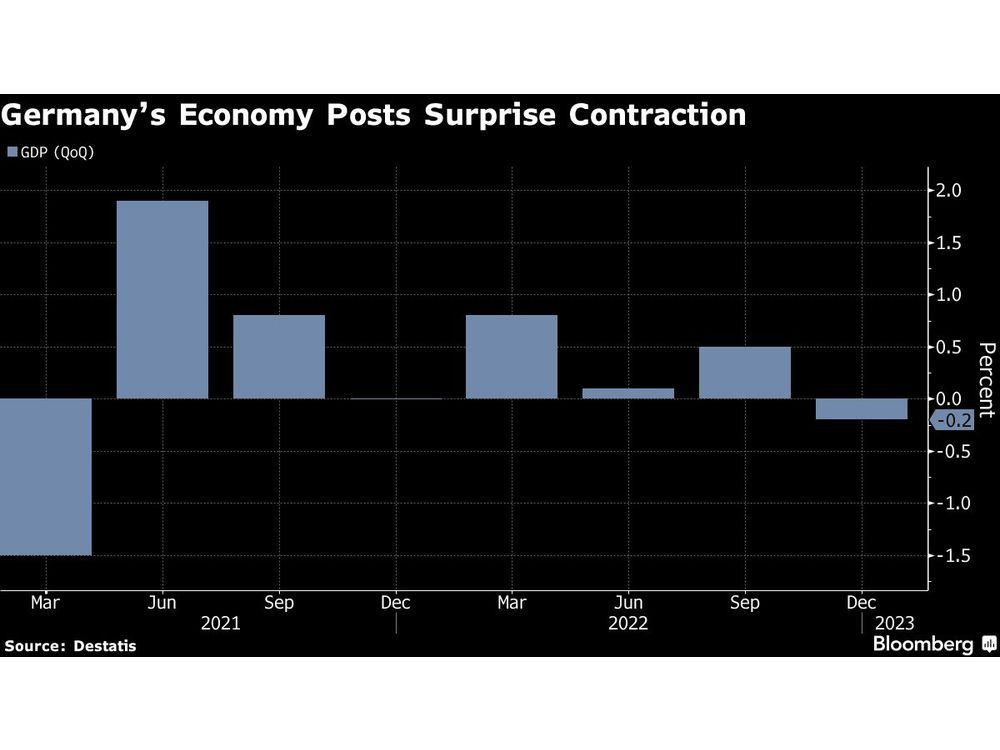
However, Germany’s economy, Europe’s largest, unexpectedly shrank by 0.2% in the fourth quarter, according to figures released Monday. Fears of lagging economic growth so far have not deterred the European Central Bank from its series of interest rate increases, which are sharply raising the cost of borrowing for businesses and consumers in an attempt to cool off inflation.

Consumer prices jumped 9.2% in December from a year earlier, far above the central bank’s goal of 2%. Rate increases are the chief antidote to excessive inflation but can slow the economy by making it more expensive to buy a house or a car on credit or borrow to expand a business.

The central bank’s governing council is expected to add another half-percentage point rate hike at its meeting Thursday.

Rate increases by other central banks around the world, including the U.S. Federal Reserve and the Bank of England, also have added strain to the global economy. ECB officials say that raising rates now and capping inflation before it gets baked into the economy avoids the need for more drastic action later.

Comments

Postmedia is committed to maintaining a lively but civil forum for discussion and encourage all readers to share their views on our articles. Comments may take up to an hour for moderation before appearing on the site. We ask you to keep your comments relevant and respectful. We have enabled email notifications—you will now receive an email if you receive a reply to your comment, there is an update to a comment thread you follow or if a user you follow comments. Visit our Community Guidelines for more information and details on how to adjust your email settings.

Adblock test (Why?)


Europe scrapes out economic growth by dodging gas disaster - Financial Post
Read More

Monday, January 30, 2023

German Recession Risk Increases After Surprise Contraction - Financial Post

Article content

(Bloomberg) — Germany’s economy shrank 0.2% at the end of last year — a worse outcome than previously flagged and one that makes a recession on the back of rising energy bills more likely after all.

Article content

The figures Monday from the statistics office contrast with an estimate this month for output to have stagnated in the fourth quarter. They also mean a contraction in the period through March would still produce a recession in the euro area’s largest economy. 

Article content

Several indicators in recent weeks have pointed to growing confidence in Germany after a mild winter and well-filled natural gas storages all but eliminated the risk of shortages during the heating period. Wholesale prices for the commodity have fallen from record highs, nurturing hopes that inflation will cool sooner than previously thought.

Demand is weighed down as surging prices continue to filter through to consumers. That trend was also visible in Sweden, whose economy unexpectedly contracted in the fourth quarter, separate data earlier Monday showed.

Article content

“We expect more of the same for early 2023, namely a modest decline in real GDP reflecting mostly lower consumption,” said Salomon Fiedler, an economist at Berenberg. “Following the mild winter recession, the economy is likely to stabilize in spring and start to expand significantly again in mid-2023.”

There was some good news elsewhere. Belgium managed to eke out growth of 0.1% and Latvia grew 0.3%, while euro-area economic confidence rose for a third month in January, climbing to the highest level since June. 

But Germany’s outsized manufacturing sector, while underpinned by a large backlog and an easing of supply bottlenecks, is seeing orders fall.

The government in Berlin last week forecast growth of 0.2% for 2023, compared with an earlier prediction for a 0.4% contraction. Economy minister Robert Habeck still warned of a possible recession, and that the crisis Russia sparked with its invasion of Ukraine isn’t over.

Article content

The outlook remains uncertain. Inflation could prove stubborn amid growing demands for higher wages. Postal workers have gone on strike to push for a 15% pay hike, and public-sector employees are also seeking a double-digit raise. 

The European Central Bank is determined to tackle surging prices with restrictive monetary policy. It’s set to lift interest rates by another 50 basis points this week, adding to what’s already the most aggressive tightening campaign in its history. The full impact of those measures has yet to be felt.

—With assistance from Joel Rinneby, Kristian Siedenburg, Barbara Sladkowska and Zoe Schneeweiss.

(Updates with economist in fifth paragraph, Latvia in sixth.)

Adblock test (Why?)


German Recession Risk Increases After Surprise Contraction - Financial Post
Read More

Polish Economy Slows as War in Ukraine and Rate Hikes Hit Growth - BNN Bloomberg

(Bloomberg) -- Poland’s economy slowed last year, weighed down by the Russia’s invasion of Ukraine and a string of rapid interest-rate increases.

Gross domestic product growth decelerated to 4.9% in 2022, the statistics office said in preliminary reading on Monday. Most economists surveyed by Bloomberg predicted a slowdown to 4.8% from revised 6.8% a year earlier. Growth was driven by industrial production, while consumer spending slowed. There was no quarterly breakdown.

The combination of flagging growth and almost quarter-century high inflation comes as Poland readies for general elections in the fall. Reacting to soaring inflation, the central bank lifted rates to the highest level in a decade, but has held off from further tightening since October. 

Governor Adam Glapinski expects Poland to slip into a brief recession in the first quarter of this year. That was prevented last year as a set of measures — including tax cuts and a break in mortgage payments — was put in place because of the war in neighboring Ukraine.

--With assistance from Barbara Sladkowska.

©2023 Bloomberg L.P.

Adblock test (Why?)


Polish Economy Slows as War in Ukraine and Rate Hikes Hit Growth - BNN Bloomberg
Read More

Parliamentarians return to House of Commons facing rocky economic year - CP24


The Canadian Press
Published Monday, January 30, 2023 5:53AM EST
Last Updated Monday, January 30, 2023 5:55AM EST

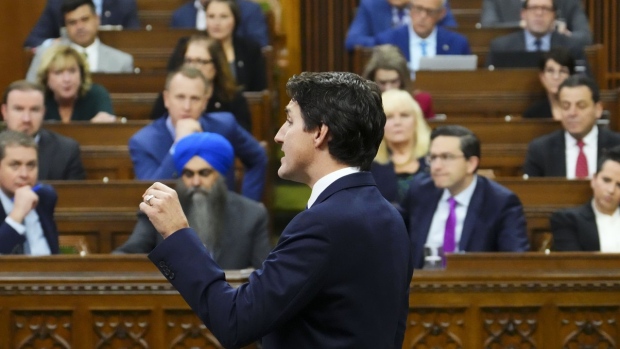
Economic matters will be top of mind for parliamentarians as they return to Ottawa to kick off a new year in federal politics.

Members of Parliament will sit in the House of Commons today for the first session of 2023 after retreating with their respective parties to strategize their priorities.

Last week, Prime Minister Justin Trudeau said his government would be focused on the cost of living and promised more targeted supports during the expected economic slowdown that would not add to inflation.

But the government has several other potentially pricey priorities to balance as it assembles its spring budget and legislative agenda, including several promises the Liberals made in their supply and confidence agreement with the NDP.

Trudeau is also about to launch negotiations with provincial premiers to increase federal health spending.

The NDP say they plan to push the Liberals to fulfil the terms of their agreement, such as the planned expansion of federal dental care, while the Conservatives led by Pierre Poilievre will focus on trying to get the government to rein in its spending.

Adblock test (Why?)


Parliamentarians return to House of Commons facing rocky economic year - CP24
Read More

Sunday, January 29, 2023

China’s Economy Shows Muted Improvement During Holiday Period - BNN Bloomberg

(Bloomberg) -- China’s economy showed a few signs of improvement in January as the country charted a path through its second month without Covid Zero curbs, though a major holiday season kept a lid on some activity.

Bloomberg’s aggregate index of eight early indicators showed a slight uptick in activity in January. That compared with a contraction in December as the economy slowed in response to a massive Covid-19 outbreak.

January marked the first time that Chinese people were able to travel during the Lunar New Year holiday period without major restrictions since the pandemic began.

Early signs showed a rise in activity as more than 300 million trips were made during the holiday, nearly 90% of pre-pandemic levels, according to the Ministry of Culture and Tourism. Box office figures were higher, too, topping last year’s holiday.

Restaurant revenue spiked nearly 25% during the festival period from a year ago, according to a survey from the China Cuisine Association, while major retail and catering firms saw their sales jump nearly 7% year-on-year, state media CCTV reported citing figures from the Ministry of Commerce.

Consumption is seen as a much-needed driving force for the world’s second-largest economy this year, particularly as the global economy cools. China’s State Council said the nation needs to accelerate its consumption recovery, CCTV reported over the weekend.

The optimism was present in major onshore stocks even before the holiday began as investors cheered the reopening and fading outbreaks. After losing momentum in December, the CSI 300 Index regained traction this month, advancing about 8% ahead of the holiday week compared with the end of last month. As trading resumed Monday, the benchmark equity gauge was set to enter a bull market.

What Bloomberg Economics Says ... 

“High frequency data signal spending surged during China’s first unrestrained Lunar New Year celebration since 2019. The end of Covid Zero appears to have released a flood of pent-up demand. Not all the data are positive, but most of them back our view that reopening will be rapid – and that consumer spending should provide key support to the recovery.”

— David Qu, economist

Read the full report here.

Other indicators weren’t as positive, either as business activity slowed during the Lunar New Year season or as the global economy continued to struggle.

Read More: China Celebrated Lunar New Year Like Covid No Longer Exists

Confidence among small businesses was better in January than in December, with real estate, transport, accommodation and catering activity seeing a sharp rebound, according to Standard Chartered Plc.

Even so, the index measuring that confidence fell just short of expansion, Standard Chartered economists Hunter Chan and Ding Shuang wrote in a note this month. They added that a sub-index measuring manufacturing activity retreated “partly due to holiday effect.”

Car and home sales fell in the first weeks of the month. Additional data from China Real Estate Information Corp., which tracks 40 major cities, showed that residential sales by area declined 14% from a year earlier during the week that included the holiday, suggesting the sector remains a concern.

Factory-gate prices, meanwhile, remained in deflation — though not as deeply as in November and December. 

Early trade data from South Korea showed the global economy is continuing to struggle, with exports falling 2.7% in the first 20 days of the month. While the headline number was better than December’s 8.8% fall, there were some concerning aspects. 

Shipments to China fell 24.4% in the period, underscoring how long the road ahead is for the recovery of the world’s second-largest economy, even after it scrapped restrictions. 

While economists have been upgrading their gross domestic product forecasts for 2023, they’ve also warned that disruptions and the Lunar New Year holiday will likely weigh on the first quarter before the rebound takes hold.

Early Indicators

Bloomberg Economics generates the overall activity reading by aggregating a three-month weighted average of the monthly changes of eight indicators, which are based on business surveys or market prices.

  • Major onshore stocks - CSI 300 index of A-share stocks listed in Shanghai or Shenzhen (through market close on the 25th of the month).
  • Total floor area of home sales in China’s four Tier-1 cities (Beijing, Shanghai, Guangzhou and Shenzhen).
  • Inventory of steel rebar, used for reinforcing in construction (in 10,000 metric tons). Falling inventory is a sign of rising demand.
  • Copper prices - Spot price for refined copper in Shanghai market (yuan/metric ton).
  • South Korean exports - South Korean exports in the first 20 days of each month (year-on-year change).
  • Factory inflation tracker - Bloomberg Economics-created tracker for Chinese producer prices (year-on-year change).
  • Small and medium-sized business confidence - Survey of companies conducted by Standard Chartered.
  • Passenger car sales - Monthly result calculated from the weekly average sales data released by the China Passenger Car Association.

--With assistance from James Mayger and Yujing Liu.

(Updates with more spending figures from Chinese media reports, Bloomberg Economics comments.)

©2023 Bloomberg L.P.

Adblock test (Why?)


China’s Economy Shows Muted Improvement During Holiday Period - BNN Bloomberg
Read More

Amid economic turmoil, Pakistan hikes up fuel prices - Al Jazeera English

The decision comes amid stalled negotiations with global lender IMF which is yet to release a crucial instalment of $1.1bn.

Pakistan has hiked up petrol and diesel prices after the country’s currency value plummeted this week and just days before an International Monetary Fund (IMF) visit to the country to discuss the stalled ninth review of Pakistan’s funding programme.

Finance minister Ishaq Dar said at a press conference on Sunday that petrol price will rise by 35 rupees to 249.80 rupees ($1) per litre while high-speed diesel would go up to 262.8 rupees ($1.05) per litre.

The announcement was made just 10 minutes before the new prices went into effect at 11am (05:00 GMT).

“We will have to take the rise in international oil prices and the devaluation of the rupee into account,” Dar said. “This rise is being done immediately on the recommendation of the oil and gas regulatory authority who said there were reports of artificial shortages and hoarding of fuel in anticipation of price rises – hence this price rise is being done immediately to combat this.”

Long lines were reported outside petrol stations after people filled their tanks ahead of the announcement.

‘Insensitive’

Reaction to Dar’s announcement was met with swift condemnation and criticism of the government’s handling of the country’s economic situation.

“How will poor survive? Why [is] this nation so insensitive about simple question of life of poor and middle classes,” Shabbar Zaidi, the former chairman of Pakistan’s Federal Bureau of Revenue, posted on Twitter.

Zartaj Rathore, a Lahore resident, said on Twitter: “Sadly this inflation will get the life of people. They’re [the government officials] not cutting their luxury expenditures all the burden and hurdles will always for the people who are paying huge taxes.”

Pakistan is in the midst of a balance of payments crisis amid the plummeting value of the rupee – which dove to a historic low after losing nearly 12 percent of its value against the US dollar earlier this week after an exchange cap was lifted.

The cash-strapped country is seeking to unlock a vital bailout from the IMF. However, the Washington-based lender has yet to approve the release of the crucial instalment of $1.1bn, originally due to be disbursed in November last year as part of a $6bn bailout package that was secured in 2019.

A successful IMF visit is critical for Pakistan, which is facing an increasingly acute balance of payments crisis and is desperate to secure external financing, with less than three weeks’ worth of import cover in its foreign exchange reserves.

Pakistan also suffered from a nationwide electricity outage earlier this week, linked to a cost-cutting measure, estimated to have cost the textile industry alone $70m.

Adblock test (Why?)


Amid economic turmoil, Pakistan hikes up fuel prices - Al Jazeera English
Read More

RVs and other economic canaries in the coal mine - USA TODAY

Carney touts B.C. port expansion plan to strengthen independence, diversify economy - Toronto Star

[unable to retrieve full-text content] Carney touts B.C. port expansion plan to strengthen independence, diversify economy    Toronto Star ...