Sunday, January 29, 2023

Spain Economy Grows More Than Expected in Boost for Sanchez - Financial Post
Article content
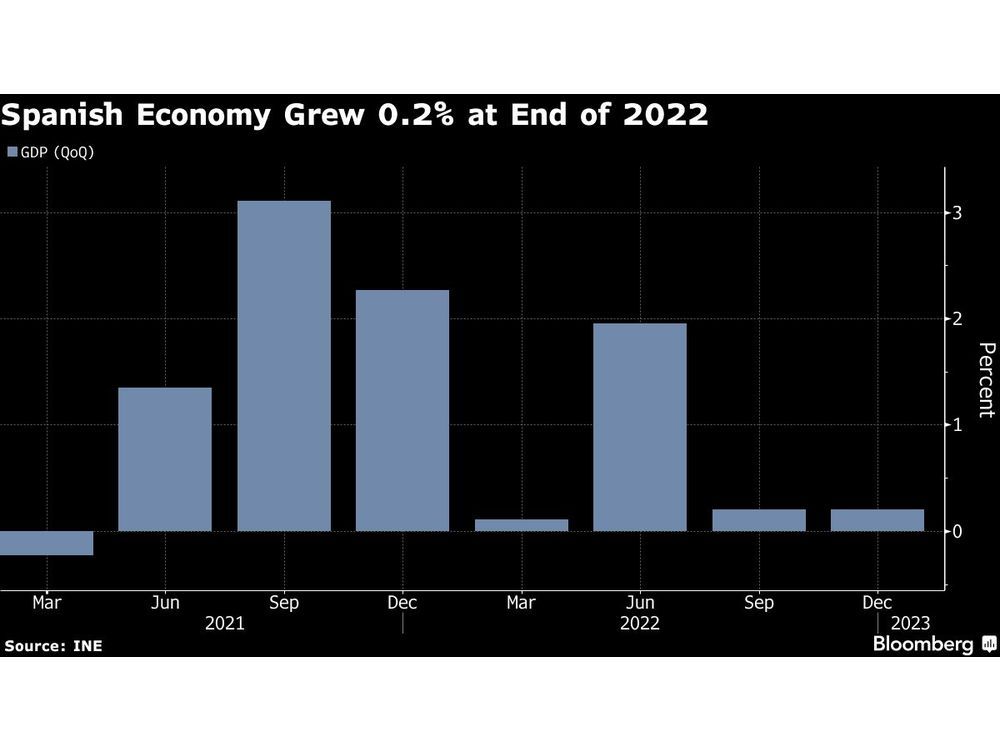
(Bloomberg) — Spain grew more than anticipated in the final quarter of last year, indicating the euro zone’s fourth-largest economy is on track to avoid a recession even as high inflation squeezes household spending.
Article content
Output rose 0.2%, according to data from the INE statistics agency published on Friday. That matches the pace in the previous quarter and exceeds the 0.1% median forecast of economists surveyed by Bloomberg. It puts 2022 growth at 5.5%, maintaining the previous year’s momentum.
Article content
Socialist Prime Minister Pedro Sanchez, who is widely expected to run for re-election this year, has pumped billions of euros into the economy in an effort to tame inflation, and shield households and businesses. The pace of price increases has eased by almost half from its July peak to 5.5% as energy costs decline.
Although growth slowed sharply in the second half of 2022, it has held up more than expected only a few months ago when most polls pointed to two consecutive quarters of contraction.
Article content
“This confirms the strength and resilience of the Spanish economy,” Sanchez wrote in a Tweet in which he defied what he called “the prophets of the apocalypse.”
Still, the higher-than-expected quarterly growth figure masks signs of weakness, according to Angel Talavera, head of European economics at Oxford Economics.
He pointed to a decline in household spending, which fell 1.8% in the fourth quarter from the previous three months, according to INE.
“The number initially is positive because it confirms that Spain will avoid a recession, but when you look at the details the data doesn’t look very good,” he said. “Most of the improvement comes from a decline in imports, which is never a good sign. I’m surprised by the decline in consumption because slowing inflation should suggest stronger spending.”
Article content
What Bloomberg Economics Says…
“The gain in headline GDP growth masks a sharp contraction in household consumption, which was down by 1.8% on the quarter. Households are struggling to keep spending, as high inflation weighs on real incomes.”
—Ana Andrade. Click here for more
Inflationary pressures in Spain, which is the largest beneficiary of funds from the EU Recovery and Resilience Facility after Italy, are expected to keep growth subdued, with the economy likely to expand only 1.1% this year, according to the International Monetary Fund’s latest estimates.
The impact of higher prices is also starting to show in the labor market. Unemployment rose slightly to 12.8% in the last quarter of the year from 12.6% in the previous three months, with the number of people employed dropping for the first time in the fourth quarter since 2017, according to INE data released on Thursday.
Spain’s GDP report comes ahead of highly anticipated growth numbers for the entire region on Tuesday. Policymakers are hoping that an unexpectedly mild winter will allow the bloc to avoid a serious slump.
—With assistance from Ainhoa Goyeneche, Joel Rinneby, Ana Andrade (Economist) and Maeva Cousin (Economist).
(Updates with Tweet from Sanchez in fifth paragraph, economist comment starting in sixth paragraph)
Spain Economy Grows More Than Expected in Boost for Sanchez - Financial Post
Read More
Ukraine's Economy Likely To Shrink Further In 2023 - OilPrice.com
- Russia’s invasion of Ukraine has taken a heavy toll on Ukraine’s economy.
- Ukraine’s GDP plunged by 30% in 2022.
- If the war continues to drag on, Ukraine will likely grow more dependent on Western financial assistance in 2023.

Russia’s re-invasion of Ukraine in February 2022 took a heavy toll on the Ukrainian economy. Moscow focused on destroying the Russian-speaking industrial heartland in the southeast, displacing millions of workers, damaging crops, smashing the power grid and blocking exports from Ukraine’s seaports. As a result, Ukraine’s gross domestic product (GDP) plunged 30 percent in 2022 (Me.gov.ua, January 5). Worse had been expected, yet the economy was able to weather the storm largely thanks to Western assistance. In 2023, everything will depend on the course of the war. If it drags on, or if Ukraine loses, the economy will continue to shrink. In any case, Ukraine will heavily rely on Western financial assistance throughout the year.
Apart from the defense industry, which Russian missiles targeted first, metallurgy, Ukraine’s main export industry before the war, took the hardest hit. The nation’s second- and third-largest steel mills, Illich and Azovstal, both located in the occupied southeastern city of Mariupol, were destroyed. The other large steel mills, all located in the front-line areas, have had to reduce production due to missile strikes and blockaded seaports. As a result, metal exports plunged 60 percent from January to November 2022 (Ukrstat.gov.ua, accessed on January 20).
The energy sector has been another major target of Moscow. Ukraine’s largest oil refinery, based in the city of Kremenchuk, was destroyed by Russian missiles in March 2022, along with large fuel reservoirs across the country (Ukrainska Pravda, Vikna.tv, April 2, 2022). In November, Russia hit gas production facilities, depleting the natural gas reserves Ukraine had accumulated for winter. As a result, Kyiv turned to foreign partners for an additional 3 billion cubic meters of gas (Naftogaz.com, December 1, 2022).
From October to November 2022, Russia, in several waves of missile strikes made possible by the West’s reluctance to send sophisticated air defense systems, damaged almost half of Ukraine’s power facilities, trying to trigger a blackout (Ukrinform.ru, November 18, 2022). The strikes have caused long power outages severely affecting Ukraine’s production capacity. An attack on November 23, 2022, triggered a temporary shutdown of all three nuclear power plants controlled by Ukraine. The fourth one, Ukraine’s largest, in Zaporizhzhia region, was occupied and stopped by Russian forces (Facebook.com/minenergoUkraine, November 23, 2022; Hromadske.ua, December 13, 2022).
Ukraine’s agricultural sector has also suffered severe damage, as large swathes of arable land have become minefields, and scores of grain silos across the country have been destroyed. Farmers have lost access to credit, seeds and fertilizers, and in the occupied areas, their harvest was looted by the invaders. Agricultural exports have also been affected by the blockade of Ukraine’s seaports. Russia eventually agreed to unblock only three of Ukraine’s seaports, in line with the August 2022 grain corridor agreement mediated by Turkey and the United Nations. Yet, this was not enough. In the marketing year which began in July 2022, grain exports have thus far plummeted 29 percent, in spite of a record harvest from 2021 (Ukranews.com, January 12).
Such huge losses caused fiscal revenues in Ukraine to plunge. Meanwhile, defense spending soared by 818 percent and accounted for a whopping 42 percent of total fiscal expenditures from January to November 2022. The economy would not have survived such a blow but for unprecedented foreign assistance, mainly from the United States and the European Union. Foreign grants accounted for 23 percent of Ukraine’s fiscal revenues in 2022 (Mof.gov,ua, accessed on January 17). International financial assistance exceeded $30 billion from February 24 to December 20, a figure unthinkable before the war (Kmu.gov.ua, December 20, 2022). Total foreign assistance, including financial, humanitarian and military, amounted to 113 billion euros ($122 billion), including 48 billion euros ($52.37 billion) from the US (Kmu.gov.ua, January 17). For comparison, Ukraine’s GDP totaled $200 billion in 2021 (The World Bank, accessed on January 18).
In 2023, Ukraine is set to rely on international assistance even more, both to defend itself and to keep its crippled economy afloat. Ukraine expects international financial assistance to grow to $38 billion this year, of which 18 billion euros ($19.64 billion) is to be contributed by the EU, at least $9.9 billion by the US and the rest mainly by international financial institutions, including the International Monetary Fund (IMF) (RBC, December 28, 2022). Ukraine has already received the first 3 billion euros ($3.27 billion) from the EU (Mof.gov.ua, January 17).
Ukraine’s exact needs will depend on the course of the war. The Ukrainian authorities and international financial institutions have thus far been cautiously optimistic, hoping that the war will end in 2023. The Ukrainian National Bank forecast in October 2022 that Ukrainian GDP will grow by 4 percent if the war ends by mid-2023, and by 2 percent if the war lasts longer (Bank.gov.ua, October 27, 2022). In November, the IMF forecast 1-percent growth for 2023 (International Monetary Fund, November 23, 2022)
Among the main complications for 2023 and onward will be re-employing the several million qualified workers who fled the war abroad or became internally displaced persons, as most are expected to return home after the war, as well as restoring Ukraine’s destroyed industry and infrastructure. The UN estimates the number of Ukrainian refugees in Europe alone at over eight million, out of a pre-war population of around 40 million (Data.unhcr.org, accessed on January 18). The Ukrainian government, EU and World Bank estimated the cost of reconstruction and recovery at $349 billion in September 2022, before the massive missile strikes on Ukraine’s power infrastructure (The World Bank, September 9, 2022).
Ukraine hopes to use the Russian assets frozen by the West, estimated at several hundred billion dollars, for reconstruction needs. European Commission President Ursula von der Leyen revealed in November 2022 that the EU was looking for mechanisms to cover part of Ukraine’s reconstruction needs from the frozen 300 billion euros ($327.29 billion) of the Russian Central Bank’s reserves and 19 billion euros ($20.73 billion) of Russian oligarchs’ funds (Ec.europa.eu, November 30, 2022). Ukraine is also sure to attract both institutional and private investors if its EU entry process continues, after the country obtained official EU candidate status this past June. The EU will assess Ukraine’s progress on the accession requirements in the fall of 2023 (Hromadske.ua, January 13). Consequently, Kyiv will aim to not only defeat Russia before the end of 2023 but also carry out those domestic reforms necessary to achieve EU membership—and Western assistance will be highly consequential in both cases.
By the Jamestown Foundation
More Top Reads From Oilprice.com:



The Jamestown Foundation
Founded in 1984, The Jamestown Foundation is an independent, non-partisan research institution dedicated to providing timely information concerning critical political and strategic developments in China,…
More InfoUkraine's Economy Likely To Shrink Further In 2023 - OilPrice.com
Read More
Saturday, January 28, 2023
Your Weekend Reading: Nobody Knows Where the US Economy Will Land - Bloomberg
[unable to retrieve full-text content]
Your Weekend Reading: Nobody Knows Where the US Economy Will Land BloombergYour Weekend Reading: Nobody Knows Where the US Economy Will Land - Bloomberg
Read More
The Economy Slows Down - WSJ - The Wall Street Journal
The Marriner S. Eccles Federal Reserve building in Washington, D.C.
Photo: Ting Shen/Bloomberg News
The Federal Reserve must be pleased with the top-line numbers in Thursday’s fourth-quarter GDP report, which showed the U.S. economy grew by a solid 2.9% while its preferred price index slowed to 3.2%. But drill down, and the economy looks to be losing momentum.
Maybe the best news from the report is that consumer spending continued to increase at a steady 2.1% and contributed about half of the GDP growth. It appears that rising interest rates haven’t yet caused consumers to pull back, though the December retail sales report showed a sharp drop in spending and could augur a slowdown.
The shift in spending toward services that began as lockdowns eased continued. Services contributed 1.16% to the consumption increase, with motor vehicle and parts chipping in 0.20%. End-of-year discounts may have moved forward purchases, and auto analysts are forecasting weak growth this year.
Businesses also restocked inventories as supply chains eased, which accounted for 1.46% of the GDP growth. Net exports also added 0.56%. But neither is likely to be sustained going forward. The other big lift to GDP came from government spending, which increased 3.7% and contributed 0.64%. Most of this was transfer payments and salaries rather than defense or public works.
The biggest cause for concern was the 6.7% fall in fixed private investment. Much of that was housing (-26.7%), owing to the sharp increase in interest rates. What the Fed giveth, it now taketh away. Capital expenditures also fell 3.7%, which signals that businesses are getting nervous and spending less on equipment that can boost worker productivity.
Intellectual property investment is holding up better, but research and development declined last quarter. One culprit may be last year’s expiration of the immediate expensing for R&D. The pullback in business investment amid higher interest rates and economic uncertainty has been evident in the ISM purchasing managers index for some time.
The economy can’t live on consumption alone, and the sharp decline in the savings rate—2.9% in the fourth quarter compared to 7.3% a year earlier—suggests that consumers may be running up credit cards to make ends meet or take the vacation they couldn’t during the pandemic. But as savings decline, so may consumer spending.
Perhaps the best news for the Fed is that real disposable personal income grew 3.3% as the personal consumption expenditure price index eased to 3.2%, down from 4.3% in the third quarter and 7.5% in the first. This suggests that its monetary medicine may be starting to work, and it might not have to raise interest rates as high as some expected a few months ago.
Recent job and unemployment claim reports also indicate that the labor market is holding up well, even as many large companies announce layoffs. Small businesses are still hiring, and China’s abandonment of zero-Covid policies will help global growth.
The biggest risks to the U.S. economy other than higher interest rates this year are probably the tax increases in the Inflation Reduction Act and a regulatory onslaught that are compounding business uncertainty. President Biden has a growing economy, and let’s hope he can keep it.
The Economy Slows Down - WSJ - The Wall Street Journal
Read More
Friday, January 27, 2023
US Economy Shows Slowdown Signs After Growing 2.9% Last Quarter - Financial Post
The US economy grew faster than forecast into the end of 2022, but there were signs of slowing underlying demand as the steepest interest-rate hikes in decades threaten growth this year.


Article content
(Bloomberg) — The US economy grew faster than forecast into the end of 2022, but there were signs of slowing underlying demand as the steepest interest-rate hikes in decades threaten growth this year.
Advertisement 2
Article content
Gross domestic product increased at a 2.9% annualized rate in final three months of 2022 after a 3.2% gain in the third quarter, the Commerce Department’s initial estimate showed Thursday. About half of the GDP increase reflected inventory growth, while government outlays matched the biggest gain since early 2021.
Article content
Personal consumption, the biggest part of the economy, climbed at a below-forecast 2.1% pace.
The mixed report suggests that the Federal Reserve still has a path to a soft landing with officials set to further downshift their rate increases next week and debate when to pause. Their preferred price gauge rose at the slowest pace in two years, while a separate report showed unemployment filings remained near historic lows.
Advertisement 3
Article content
The data showed some signs of stress for American consumers whose wages have failed to keep up with inflation and continued to encourage them to draw down savings accumulated from government pandemic-relief programs. The burden of elevated prices and higher borrowing costs is mounting, pointing to a tenuous outlook for the economy.
“When we look at what’s happening with the consumer, which is the backbone of the US economy, we are seeing a clear loss of momentum,” Lindsey Piegza, chief economist at Stifel Nicolaus & Co., said on Bloomberg Television.
“Without the consumer happy and healthy out in the marketplace, we simply cannot expect to maintain positive growth, let alone more robust growth similar” to the end of last year, she said.
Advertisement 4
Article content
Follow the reaction in real-time here on Bloomberg’s TOPLive blog
A key gauge of underlying demand that strips out the trade and inventories components — inflation-adjusted final sales to domestic purchasers — rose an annualized 0.8% in the fourth quarter after a 1.5% gain. Final sales to private domestic purchasers climbed just 0.2%, the weakest since the second quarter of 2020.
What Bloomberg Economics Says…
“Consumer spending on services drove the economy to solid growth in the fourth quarter, but the good news ends there. Two measures of underlying activity that strip out volatile components — including trade, inventory swings, and government spending — showed considerably milder growth.”
— Eliza Winger, economist
Advertisement 5
Article content
For the full note, click here
The latest Bloomberg monthly survey shows economists see the economy shrinking in the second and third quarters, putting 65% odds on a recession in the coming year.
The S&P 500 opened higher, Treasury yields rose and the dollar was little changed after the GDP report and better-than-expected weekly jobless claims. Applications for unemployment insurance dropped to 186,000 last week, the lowest since April.
Recent data show cracks are developing more broadly. Retail and motor vehicle sales data showed households are starting to retrench, the housing market continues to weaken and some businesses are reconsidering capital spending plans.
As the Fed continues to hike interest rates to ensure inflation is extinguished, housing and manufacturing have deteriorated quickly while industries including banking and technology are carrying out mass layoffs.
Advertisement 6
Article content
Read more: US Recession Call Trickier Than Ever as Mixed Signals Abound
The GDP report showed the personal consumption expenditures price index, a key inflation metric for the Fed, rose at an annualized 3.2% rate in the fourth quarter, the slowest since 2020 and down from a 4.3% pace in the prior three months.
The core index that excludes food and energy climbed at a 3.9% rate, the slowest since the first quarter of 2021 after 4.7% paces in the prior two quarters. Monthly data for December will be released Friday.
The moderation in price pressures is consistent with forecasts that the Fed will further scale back its tightening campaign next week, when it’s expected to raise rates by 25 basis points. Policymakers boosted the benchmark rate by 50 points in December after 75 basis-point hikes at their previous four meetings.
Advertisement 7
Article content
Last Year
The world’s largest economy expanded 2.1% last year. In 2021, when demand snapped back from pandemic-related shutdowns, the economy grew 5.9% — the best performance since 1984.
The GDP data showed services spending increased at 2.6% annualized rate in the October-December period, the slowest since last year’s first quarter. Outlays on goods rose at a 1.1% pace, the first advance since 2021.
Business investment slowed sharply after a third-quarter surge. Spending on equipment declined an annualized 3.7%, the most since the second quarter of 2020.
Another report Thursday showed bookings for nondefense capital goods excluding aircraft, a proxy for business investment, dropped 0.2% in December — the most in three months.
Advertisement 8
Article content
How Executives See It
- “The outlook for 2023 remains uncertain. In the US, central bank rate increases of started to have an impact on inflation, but they are also lowering the growth trajectory of the economy.” — David Solomon, CEO at Goldman Sachs Group Inc., Jan. 17 earnings call
- “The activity we’re seeing feels okay. But we are, like everybody else, a bit nervous about where things are going.” — Daniel Florness, CEO at Fastenal Co., Jan. 19 earnings call
- “If past behavior over the last six months, nine months is any indication, I think the consumer is relatively steady in the US, which gives us great confidence.” — Andre Schulten, chief financial officer at Procter & Gamble Co, Jan. 19 earnings call
- “This is not going to be like a normal recession, that’s why you hear us and others talking about the manageability and the mildness that’s likely if we do have one.” — Jane Fraser, chief executive officer at Citigroup Inc., Jan. 13 earnings call
Residential investment slumped at a 26.7% annual pace, marking the seventh-straight quarterly decline. Home sales fell last year by the most since 2008 as mortgage rates skyrocketed.
Inventories contributed 1.46 percentage points to GDP, while trade added 0.56 percentage point. Separate data on Thursday showed the merchandise-trade gap widened last month to the largest on record due to the biggest-ever increase in imports. The figures aren’t adjusted for inflation.
—With assistance from Reade Pickert, Kristy Scheuble and Katia Dmitrieva.
(Updates with market open)
US Economy Shows Slowdown Signs After Growing 2.9% Last Quarter - Financial Post
Read More
Spain Economy Grows More Than Expected in Boost for Sanchez - Financial Post
Article content
(Bloomberg) — Spain grew more than anticipated in the final quarter of last year, indicating the euro zone’s fourth-largest economy is on track to avoid a recession even as high inflation squeezes household spending.
Article content
Output rose 0.2%, according to data from the INE statistics agency published on Friday. That matches the pace in the previous quarter and exceeds the 0.1% median forecast of economists surveyed by Bloomberg. It puts 2022 growth at 5.5%, maintaining the previous year’s momentum.
Article content
Socialist Prime Minister Pedro Sanchez, who is widely expected to run for re-election this year, has pumped billions of euros into the economy in an effort to tame inflation, and shield households and businesses. The pace of price increases has eased by almost half from its July peak to 5.5% as energy costs decline.
Although growth slowed sharply in the second half of 2022, it has held up more than expected only a few months ago when most polls pointed to two consecutive quarters of contraction.
Article content
“This confirms the strength and resilience of the Spanish economy,” Sanchez wrote in a Tweet in which he defied what he called “the prophets of the apocalypse.”
Still, the higher-than-expected quarterly growth figure masks signs of weakness, according to Angel Talavera, head of European economics at Oxford Economics.
He pointed to a decline in household spending, which fell 1.8% in the fourth quarter from the previous three months, according to INE.
“The number initially is positive because it confirms that Spain will avoid a recession, but when you look at the details the data doesn’t look very good,” he said. “Most of the improvement comes from a decline in imports, which is never a good sign. I’m surprised by the decline in consumption because slowing inflation should suggest stronger spending.”
Article content
What Bloomberg Economics Says…
“The gain in headline GDP growth masks a sharp contraction in household consumption, which was down by 1.8% on the quarter. Households are struggling to keep spending, as high inflation weighs on real incomes.”
—Ana Andrade. Click here for more
Inflationary pressures in Spain, which is the largest beneficiary of funds from the EU Recovery and Resilience Facility after Italy, are expected to keep growth subdued, with the economy likely to expand only 1.1% this year, according to the International Monetary Fund’s latest estimates.
The impact of higher prices is also starting to show in the labor market. Unemployment rose slightly to 12.8% in the last quarter of the year from 12.6% in the previous three months, with the number of people employed dropping for the first time in the fourth quarter since 2017, according to INE data released on Thursday.
Spain’s GDP report comes ahead of highly anticipated growth numbers for the entire region on Tuesday. Policymakers are hoping that an unexpectedly mild winter will allow the bloc to avoid a serious slump.
—With assistance from Ainhoa Goyeneche, Joel Rinneby, Ana Andrade (Economist) and Maeva Cousin (Economist).
(Updates with Tweet from Sanchez in fifth paragraph, economist comment starting in sixth paragraph)
Spain Economy Grows More Than Expected in Boost for Sanchez - Financial Post
Read More
-
[unable to retrieve full-text content] The end of the rip-off economy The Economist The end of the rip-off economy - The Economist Rea...
-
[unable to retrieve full-text content] Maui mayor's plan to phase out vacation rentals would increase housing but shrink the economy ...
-
The political economy theory (PET) known as an amalgam of different social and economic sciences. It doesn’ts solely interpret economy as ...
