Rechercher dans ce blog

Sunday, July 4, 2021

Why more highway spending won’t rev up the economy - Livemint

Economists aren’t so sure. A wide body of research focused on the effects of highway spending suggests that major new investment in U.S. roads would generate little, if any, long-term economic gain.

While the projects would spur hiring and spending temporarily, both when they are announced and under way, they aren’t likely to raise the economy’s productivity and, in turn, its overall growth potential in a lasting way, many researchers find.

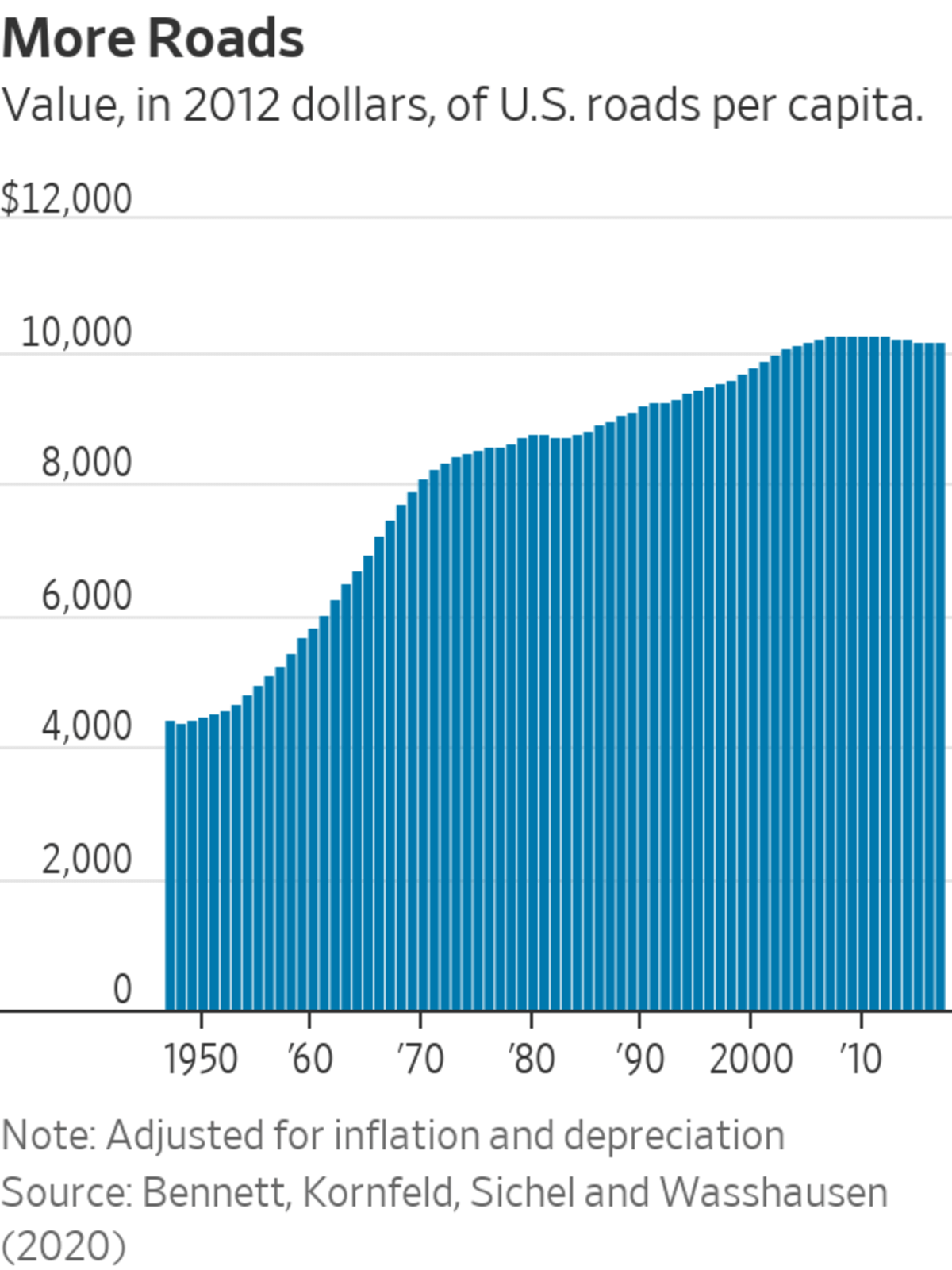
That is because the US already has an extensive system of roads, so building more wouldn’t add much to productivity, economists say.

“Highways can generate a boost for the short run, but in the long run that seems to be dubious," said Gilles Duranton, an economist at the University of Pennsylvania.

New spending for roads accounts for the largest single share—roughly 19%—of the $579 billion in new spending that the White House and a group of lawmakers have agreed to. Both Democrats and Republicans say that money would raise the economy’s productivity, defined as the level of output per hour worked.

President Biden last week touted the agreement as delivering “higher productivity and higher growth for our economy over the long run."

Sen. Rob Portman, an Ohio Republican who helped craft the deal, said last month that the plan would “increase our productivity as a country."

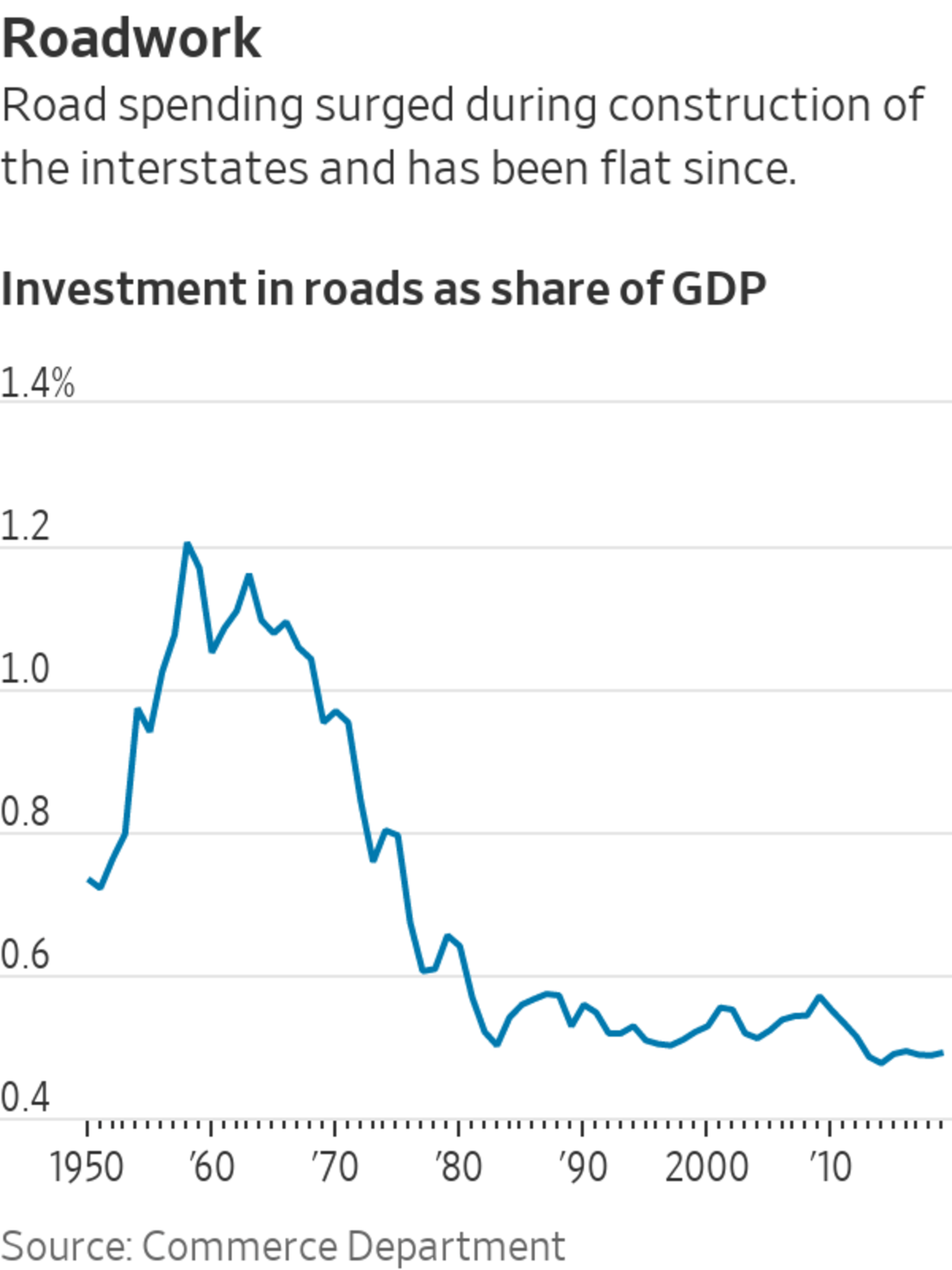
Development of the U.S. interstate highway system between the 1950s and 1970s—currently 47,000 miles of multilane highways stretching coast to coast—did make the economy much more productive, John Fernald, an economist at the Federal Reserve Bank of San Francisco, wrote in a 1999 paper.

The system meant a cross-country trip that used to take months could be accomplished in days. Businesses gained access to new suppliers and new customers. Cities were able to specialize in certain industries. International trade opened up. By one estimate, the U.S. economy would be 3.9% smaller today without the interstate highway system.

But those gains all came about when the highways were built. By now, the gains have been reaped.

“Building the interstate highway system was enormously productive," Mr. Fernald said. “That does not imply that building a second one would be equally productive."

Other research has reached similar conclusions.

Charles Hulten, an economist at the University of Maryland, found that infrastructure investment in developing countries like India resulted in increased productivity and higher growth rates. In developed countries with vast road networks, such as the U.S., new investment resulted in no change in overall productivity and growth.

A group of economists in Spain studying that country’s infrastructure spending between 1964 and 1991 concluded that the investment earlier in the period produced greater economic gains than investments later, when much of the infrastructure was already in place.

Researchers have also found that in developed countries, whatever local benefits come from highway improvements come at the expense of other locations. In other words, road spending reallocates the pie but doesn’t make it bigger.

Mr. Duranton and two co-authors, Geetika Nagpal and Matthew Turner, both of Brown University, suggested in a paper last year that new investments “lead to a displacement of economic activity while net growth effects are limited."

That’s not to say that billions of dollars in new government road spending wouldn’t boost growth in the short term. But the gains would come about as the result of the construction, and would dissipate once all the projects are completed.

In a 2012 paper, San Francisco Fed economists Sylvain Leduc and Daniel Wilson found that new spending on roads can boost an area’s economy at two specific times: immediately after the new spending has been announced, and six to eight years later, when construction is under way. Beyond 10 years, there were no economic benefits to infrastructure spending, they found.

Moreover, the immediate effect applies only during recessions, they wrote. It’s unclear whether the U.S. would see that short-term boost now that the economy is expanding rapidly.

Some of the spending lawmakers are considering could ease congestion. But those improvements would also be temporary. Adding more highway lanes to ease congestion tends to encourage more people to use those lanes, making them congested once more, a phenomenon known as “induced demand."

A 2011 paper by Mr. Duranton and Mr. Turner found that areas that added road miles saw a proportional increase in driving, resulting in the same overall traffic levels.

Even if long-term benefits are limited, there is still a case to be made for spending money on roads, economists say. Filling potholes could provide a more comfortable driving experience, for instance.

“The more comfortable ride is getting you the improved quality of life but it’s not necessarily adding tons of private sector productivity," Mr. Fernald said.

Subscribe to Mint Newsletters

* Enter a valid email

* Thank you for subscribing to our newsletter.

Never miss a story! Stay connected and informed with Mint. Download our App Now!!

Adblock test (Why?)


Why more highway spending won’t rev up the economy - Livemint
Read More

Explaining ‘Bad News for the Economy Is Good News for the Stock Market’ - The Wall Street Journal

A little bit of bad news can be good for financial markets.

A little bit of bad news can be good for financial markets.

Illustration: Paul Blow

With some frequency, Wall Street professionals use this phrase: “Bad news for the economy is good news for the stock market.” They also use it in reverse, with good news for the economy said to be bad for stocks.

At first glance, whichever way you read it, the line might seem to make little sense. Many people see the economy and the stock market as inextricably linked. In their minds, if the economy is weakening, then surely company profits will suffer, which will end up sending stock prices lower. But that’s not always the case.

Share Your Thoughts

Are there any investing terms that confuse you? Join the conversation below.

It’s only when looking deeper that things become clearer, but even then, there are some subtleties to navigate.

“A little bit of bad news is good for markets,” says Bruce Monrad, chairman and portfolio manager at Boston-based mutual-fund company Northeast Investors Trust. It all revolves around the response by the Federal Reserve to economic news. When the news for the economy is bad, such as a sudden unexpected rise in the unemployment rate, then it is less likely that the Fed’s monetary-policy committee will raise the cost of borrowing money—a key variable for both business and consumer finances. That tends to help keep prices for stocks and bonds buoyant, Mr. Monrad says.

But too much bad news is indeed bad for stocks. “The bad news can’t be so bad that it brings into question future earnings,” Mr. Monrad says. For instance, in the early days of the Covid-19 pandemic, news of the global viral outbreak sent markets into a tailspin starting around mid-February 2020 through late March. The S&P 500 index dropped more than 30% over that period, in anticipation of the pandemic’s economic impact. The U.S. economy shrank at an annualized rate of 31% in the second quarter of last year, government statistics show.

Currently, the U.S. economy is looking strong, and that means the Fed is likely drawing closer to raising interest rates. “Fed officials continue to tilt hawkish,” says a recent report from New York-based investment bank Brown Brothers Harriman.

So, that’s good economic news that could be bad for stocks—but maybe not just yet. Interest rates have been so low for so long that it has long been anticipated that the next move in rates will be up. So until rates actually rise, or at least are expected to rise sooner than they are now, the market may continue to climb as the economy improves, some analysts say. And against that backdrop, bad news could lose some of its luster for the market.

“I think we should be in a place where good news is good news,” says Peter Tchir, head of global macro strategy at Academy Securities in New York. “Right now, if we get further bad news, we might get markets going down.”

Mr. Constable is a writer in Edinburgh, Scotland. He can be reached at reports@wsj.com.

Adblock test (Why?)


Explaining ‘Bad News for the Economy Is Good News for the Stock Market’ - The Wall Street Journal
Read More

Rishi Sunak has been running the economy on autopilot but needs to change course - The Guardian

[unable to retrieve full-text content]

Rishi Sunak has been running the economy on autopilot but needs to change course  The Guardian
Rishi Sunak has been running the economy on autopilot but needs to change course - The Guardian
Read More

Why More Highway Spending Won’t Rev Up the Economy - The Wall Street Journal

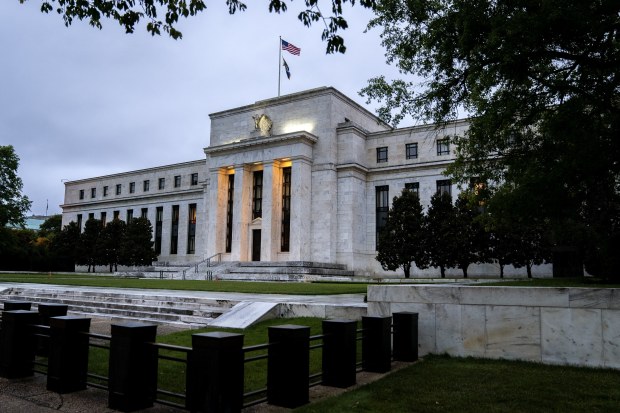
U.S. economic-growth prospects won’t necessarily benefit long term from billions of dollars in spending on roads and highways, economists find; the Federal Reserve building in Washington, D.C.

U.S. economic-growth prospects won’t necessarily benefit long term from billions of dollars in spending on roads and highways, economists find; the Federal Reserve building in Washington, D.C.

Photo: Stefani Reynolds/Bloomberg News

One of the few things that Democrats and Republicans agree on is that spending billions of dollars on America’s roads would boost productivity and the U.S. economy’s growth prospects.

Economists aren’t so sure. A wide body of research focused on the effects of highway spending suggests that major new investment in U.S. roads would generate little, if any, long-term economic gain.

While the projects would spur hiring and spending temporarily, both when they are announced and under way, they aren’t likely to raise the economy’s productivity and, in turn, its overall growth potential in a lasting way, many researchers find.

That is because the U.S. already has an extensive system of roads, so building more wouldn’t add much to productivity, economists say.

“Highways can generate a boost for the short run, but in the long run that seems to be dubious,” said Gilles Duranton, an economist at the University of Pennsylvania.

New spending for roads accounts for the largest single share—roughly 19%—of the $579 billion in new spending that the White House and a group of lawmakers have agreed to. Both Democrats and Republicans say that money would raise the economy’s productivity, defined as the level of output per hour worked.

President Biden last week touted the agreement as delivering “higher productivity and higher growth for our economy over the long run.”

Sen. Rob Portman, an Ohio Republican who helped craft the deal, said last month that the plan would “increase our productivity as a country.”

Development of the U.S. interstate highway system between the 1950s and 1970s—currently 47,000 miles of multilane highways stretching coast to coast—did make the economy much more productive, John Fernald, an economist at the Federal Reserve Bank of San Francisco, wrote in a 1999 paper.

VIDEO

President Biden’s infrastructure plan calls for non-traditional projects like the removal of some highways. What Democrats want for cities like Baltimore says a lot about the President’s goals in the next wave of development. Photo: Carlos Waters/WSJ The Wall Street Journal Interactive Edition

The system meant a cross-country trip that used to take months could be accomplished in days. Businesses gained access to new suppliers and new customers. Cities were able to specialize in certain industries. International trade opened up. By one estimate, the U.S. economy would be 3.9% smaller today without the interstate highway system.

But those gains all came about when the highways were built. By now, the gains have been reaped.

“Building the interstate highway system was enormously productive,” Mr. Fernald said. “That does not imply that building a second one would be equally productive.”

Other research has reached similar conclusions.

Charles Hulten, an economist at the University of Maryland, found that infrastructure investment in developing countries like India resulted in increased productivity and higher growth rates. In developed countries with vast road networks, such as the U.S., new investment resulted in no change in overall productivity and growth.

A group of economists in Spain studying that country’s infrastructure spending between 1964 and 1991 concluded that the investment earlier in the period produced greater economic gains than investments later, when much of the infrastructure was already in place.

Researchers have also found that in developed countries, whatever local benefits come from highway improvements come at the expense of other locations. In other words, road spending reallocates the pie but doesn’t make it bigger.

SHARE YOUR THOUGHTS

Is the U.S. spending enough or too much money on roads and bridges? Join the conversation below.

Mr. Duranton and two co-authors, Geetika Nagpal and Matthew Turner, both of Brown University, suggested in a paper last year that new investments “lead to a displacement of economic activity while net growth effects are limited.”

That’s not to say that billions of dollars in new government road spending wouldn’t boost growth in the short term. But the gains would come about as the result of the construction, and would dissipate once all the projects are completed.

In a 2012 paper, San Francisco Fed economists Sylvain Leduc and Daniel Wilson found that new spending on roads can boost an area’s economy at two specific times: immediately after the new spending has been announced, and six to eight years later, when construction is under way. Beyond 10 years, there were no economic benefits to infrastructure spending, they found.

Moreover, the immediate effect applies only during recessions, they wrote. It’s unclear whether the U.S. would see that short-term boost now that the economy is expanding rapidly.

Some of the spending lawmakers are considering could ease congestion. But those improvements would also be temporary. Adding more highway lanes to ease congestion tends to encourage more people to use those lanes, making them congested once more, a phenomenon known as “induced demand.”

A 2011 paper by Mr. Duranton and Mr. Turner found that areas that added road miles saw a proportional increase in driving, resulting in the same overall traffic levels.

Even if long-term benefits are limited, there is still a case to be made for spending money on roads, economists say. Filling potholes could provide a more comfortable driving experience, for instance.

“The more comfortable ride is getting you the improved quality of life but it’s not necessarily adding tons of private sector productivity,” Mr. Fernald said.

Write to David Harrison at david.harrison@wsj.com

Adblock test (Why?)


Why More Highway Spending Won’t Rev Up the Economy - The Wall Street Journal
Read More

Greek economy won't close again because of COVID-19, PM says - Reuters

ATHENS, July 4 (Reuters) - Greece's economy would not close again because of the coronavirus pandemic if it was just to protect an unvaccinated minority, Prime Minister Kyriakos Mitsotakis said in a newspaper interview released on Sunday.

Greece has fared well in the first wave of the COVID-19 last year. But a resurgence in COVID-19 infections has forced the country to impose lockdown restrictions since November which have cost many billions of euros to an economy slowly emerging from a decade-long crisis.

Greece has been easing restrictions as infections fall, but concerns are rising about the spread of the more contagious Delta variant.

With about 35% of its 11 million population fully inoculated, the government last week offered young people cash and phone data to boost vaccination rates.

"When we imposed across-the-board measures, there were no vaccines," Mitsotakis told Kathimerini newspaper. "We do have vaccines now."

Mitsotakis said he can't make vaccinations mandatory. "But everyone assumes his responsibility. The country will not close again for the protection of a few unvaccinated."

Mitsotakis said that he hoped that relations between Greece and Turkey will be better this summer than last summer when the two historic rivals came close to armed conflict.

The two NATO allies, at odds over competing territorial claims in the eastern Mediterranean to migrant boats and the status of Cyprus, have been trying to lower tensions since.

"I am more certain that the summer of 2021 will be calmer than the summer of 2020," Mitsotakis said.

However, we have not solved our differences all of a sudden and there will be consequences for Turkey if it opted to fuel tensions, he added.

Reporting by Angeliki Koutantou Editing by Raissa Kasolowsky

Our Standards: The Thomson Reuters Trust Principles.

Adblock test (Why?)


Greek economy won't close again because of COVID-19, PM says - Reuters
Read More

Bahrain's Economy Set to Grow 3.1% This Year And Next - Bloomberg

Sign up for our Middle East newsletter and follow us @middleeast for news on the region.

Bahrain’s economy is expected to grow 3.1% this year and next, recovering from last year’s downturn.

Gross domestic product contracted 2.1% during the first quarter, according to the Ministry of Finance and National Economy.

  • Non-oil sector output shrunk 3% in 1Q vs year ago
  • Oil economy grew 2%
  • Non-oil economy is set to see 3.8% growth this year and 3.7% in 2022, while oil economy growth is set to remain at 0% both years
  • Preliminarily projections show GDP contracted 5.1% last year

The International Monetary Fund expects Bahrain’s economy to grow 3.3% this year. The island nation is set to have one of the region’s widest deficits at about 9% of GDP this year, while its debt ratio in relation to economic output is seen as the highest in the Gulf.

    Adblock test (Why?)


    Bahrain's Economy Set to Grow 3.1% This Year And Next - Bloomberg
    Read More

    Saturday, July 3, 2021

    Progress on COVID and economy under Biden, but disunion haunts U.S. on its 245th birthday - Financial Post

    Article content

    Most U.S. adults are vaccinated but COVID-19 cases are rising. The economy is accelerating but inflation looms. Bipartisan cooperation has improved but political rancor is high.

    More than five months into Joe Biden’s presidency, the United States has changed in multiple ways, with a healthier business outlook and a pandemic – at least in many parts of the country – increasingly under control.

    But as the world’s largest economy celebrates its 245th birthday on July 4, the Independence Day holiday will not be the full celebration that Biden had hoped, or promised.

    Advertisement

    Article content

    A White House goal of vaccinating 70% of adults against COVID-19 with at least one shot will not be met, and legislation to repair the nation’s infrastructure is still far from arriving on Biden’s desk.

    Biden will celebrate with a 1,000-person party on the White House lawn and fireworks over the National Mall. Historians said he, and the country, have a reason to do so.

    “Compare where we are versus a year ago economically, in terms of public health, in terms of national psyche, it is almost like living in a different country,” said presidential historian Michael Beschloss.

    He said Biden had to walk a careful line between celebrating the progress made on the pandemic and declaring: Mission Accomplished.

    “If Biden had been too hasty in declaring the pandemic over, which he has not, it would be difficult to ask Americans for future sacrifices and it would also make Democrats politically vulnerable next year if the pandemic in some way recurs,” Beschloss said.

    Advertisement

    Article content

    Trouble may loom ahead, though. The U.S. government said on Thursday that daily coronavirus cases rose in the past week, driven by increases in the Midwest and Southeast where vaccination rates are low and the highly contagious Delta variant, first found in India, is spreading.

    “We are celebrating, as a country, at the same time as we recognize the fact that we’re in a serious situation for those who have not been vaccinated,” said infectious disease expert Dr. Anthony Fauci. “And the message is: Get vaccinated.”

    DIFFERENT PROBLEMS

    In a sign of economic progress, the Labor Department said on Friday that U.S. companies hired the most workers in 10 months in June.

    But the economy is far from back to normal, with 7 million fewer jobs than it had in February 2020, before the pandemic. Meanwhile some businesses are having trouble hiring the employees they need, as workers struggling with childcare or worried about illness choose to stay home https://ift.tt/36caPHK.

    Advertisement

    Article content

    Vanderbilt University historian Thomas Alan Schwartz noted the country’s challenges had changed since the tumultuous tenure of former President Donald Trump.

    “Our problems are really different now,” he said. “I think Joe Biden’s America is a calmer, gentler place.”

    Demonstrations over racial disparities have fallen after massive unrest in 2020 over the death of George Floyd, a Black man, and the white police officer charged with murdering him was sentenced to 22-and-a-half years in prison.

    Biden commemorated https://ift.tt/2V96HWZ the 1921 massacre of Black Americans in Tulsa, Oklahoma, last month and signed a bill into law making June 19 a federal holiday commemorating the emancipation of the enslaved.

    Advertisement

    Article content

    At the same time, threats from home grown extremism, particularly white supremacists, are on the rise, Biden’s Justice Department has said.

    And a Republican-led fight against “critical race theory” has turned the teaching of American history into a new political battleground https://ift.tt/3yjDB5d.

    Despite Biden’s pledge to get Republicans and Democrats in Congress to work together – and massive popular support – legislation on infrastructure, police reform, and gun safety still has not crossed his desk.

    The Jan. 6 storming of the Capitol by Trump supporters, during which five people died including a Capitol Police officer, remains an open wound. House of Representatives Republican leader Kevin McCarthy has criticized members of his party who cooperate with a committee set up by Democratic Speaker Nancy Pelosi to investigate the insurrection.

    Advertisement

    Article content

    Still, McCarthy attended a White House event on Friday to honor the Los Angeles Dodgers baseball team, the 2020 World Series winners. Baseball is the quintessential American pastime.

    “As we beat this pandemic and celebrate fans coming back to stadiums, we celebrate something else: a national achievement,” Biden said, hailing how frontline workers, friends, families and neighbors came together to look out for one another. “Together, as a nation, we have proved that it truly is never a good bet to bet against America.”

    Asked about the future of Biden-backed infrastructure spending in Congress, McCarthy told a reporter he was only there to celebrate the Dodgers. (Reporting by Jeff Mason; Additional reporting by Andrea Shalal; Editing by Heather Timmons and Daniel Wallis)

    Advertisement

    In-depth reporting on the innovation economy from The Logic, brought to you in partnership with the Financial Post.

      Comments

      Postmedia is committed to maintaining a lively but civil forum for discussion and encourage all readers to share their views on our articles. Comments may take up to an hour for moderation before appearing on the site. We ask you to keep your comments relevant and respectful. We have enabled email notifications—you will now receive an email if you receive a reply to your comment, there is an update to a comment thread you follow or if a user you follow comments. Visit our Community Guidelines for more information and details on how to adjust your email settings.

      Adblock test (Why?)


      Progress on COVID and economy under Biden, but disunion haunts U.S. on its 245th birthday - Financial Post
      Read More

      Carney touts B.C. port expansion plan to strengthen independence, diversify economy - Toronto Star

      [unable to retrieve full-text content] Carney touts B.C. port expansion plan to strengthen independence, diversify economy    Toronto Star ...